Sunday, April 28, 2013

Alcyone -- Hull number one


Alcyone under sail. (From the Columbia Yachts Owner's web site.)
I needed a break from not working on my boat yesterday so I ambled to the little marina store for a Pepsi. I did a double take when I looked at G Dock and saw another Columbia. No, not just a Columbia, a Columbia 43 (building excitement)! No, not just any Columbia 43... Alcyone -- the first Columbia 43! And it's in a permanent slip too, not a transient one.
Alycone in her new berth in Newport, Oregon. 

Check out that deck house! The hull-to-deck joint is different as is the toe rail and other features of the boat. 

Alcyone is distinctive because she was built with a cut down Columbia 50 deck on her. She really looks different, in a custom, cool way. It looks like she has a few inches less freeboard as well. Putting a Columbia 50 deck on the Columbia 43 isn't as weird as it sounds. Both boats have the same maximum beam (12 feet 3 inches) and the 50's waterline is only a foot more than the 43. Of course both boats were designed by Bill Tripp. I wonder how he felt about hull number one?

In Greek myth, Alcyone was the daughter of Aeolus, the Greek god of the wind. A very cool name for a sailboat.
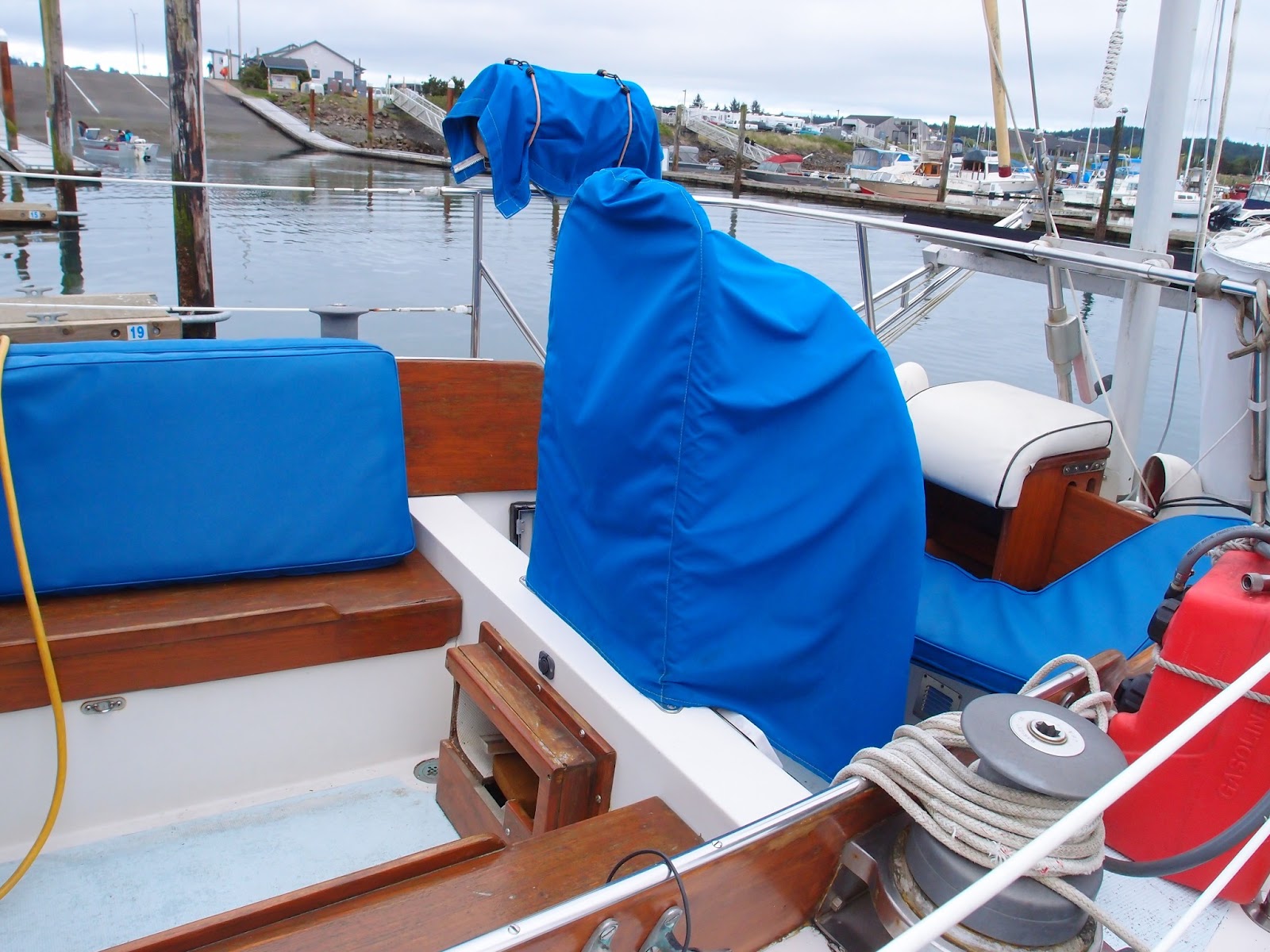
The cockpit is different from other Columbia 43s with all-wood combings and a separate well for the helmsman.

I can hardly wait to talk to Dave and Betsy, the owners. I'm hoping for a tour down below and some good stories. I've never seen another Columbia 43 and I didn't see mine before she was modified so extensively. It's interesting that there are two Columbia 43s in the same marina and both are unusual.

Tuesday, April 23, 2013

LEDs for Earth Day

An original dome light and an old German-made reading lamp are updated withe new LED lights.
Earth Day found my son-in-law and I rewiring old brass lighting fixtures and replacing the incandescent bulbs with LEDs. The original dome lights were little more than lumps of corrosion in one of the many boxes of gear that came with Oceanus. My wife and I spent several evenings polishing them down to the shine. We tried every commercially available potion to little effect. As a last resort we used a dollop of distilled vinegar on a fist-full of salt and were finally able - with a lot of elbow grease - to cut through the verdigris.

The beautiful diamond-patterned glass lenses came sparkling clean in the dishwasher. We were able to save most of the sockets, but all the switches were toast. By the time we replaced switches and added LED lights we were at or above the price of new dome lights. These, however, were part of the original boat and we felt it was important to save them. Besides, they are good-looking and classics.

In addition to the five original dome lights, we added two German-made reading lamps from about the same era we found at a yacht equipment resale store. They received LEDs as well. New strip LEDs will go under the cabinets in the galley and in the head. We will more than double the light sources in Oceanus from her original five dome lights. And the LEDs promise to be brighter too.

The LEDs are expensive to purchase, but with their long life-span (about 20,000 hours) they should eventually pay for themselves. Their real benefit on a sailboat, however, is how energy-efficient they are. They draw less than 5 percent of the energy of the incandescent bulbs they replace and do it without adding heat, which should be a boon in the tropics.

One of the attractions for me of cruising in a sailboat is being somewhat energy independent. Living off the grid and lowering my carbon footprint is a goal I've had for some time. I hope the LEDs will help me get there. Happy Earth Day.

Tuesday, April 2, 2013

An accent chair for the library

The slip cover was a perfect fit on the first try.
Virginia spotted this chair even before we signed the papers on Oceanus. "It would be perfect for sitting and knitting," she said. It was half off the day we spotted it, so, uncharacteristically, we made an impulse buy.

The original cover zips off and on.
Even though it is made to be hauled around -- in the cockpit, on deck, on the dock -- we figure the perfect place for the chair is next to the hanging locker across from our bunk. I installed a bookshelf there and we've taken to calling it the "library." Every proper yacht should have a library with a comfy reading (excuse me) knitting chair. Right?

The dark blue cover was fairly good looking, but it didn't match the family of fabrics we will use on the boat. Virginia solved this by using the old cover as a pattern and sewing a new, fitted slip
cover.
The library chair in it's rightful place.

Saturday, March 16, 2013

Co-conspirators in The Escape

Without a doubt the most fun part of rebuilding Oceanus is working with my wife. She is smart and hard working with skills that complement my own. She is constantly coming up with ideas that will make the boat more livable and beautiful  -- and then helping me bring them to life.

Jobs that I hate, or I'm not good at, she tackles with aplomb. It was such a relief to be able to turn over all of the painting to her. She is fast and good at it. She kept me racing along with the filling, sanding and other prep work so she would have things to paint during our weekends together working on the boat.

Popping plugs: The Plug Queen at work. More than 800 plugs so far and counting.
When I grumbled about all the screw holes that needed to be plugged after installing the ceiling, she volunteered to do it. She soon became the Plug Queen, spending hours gluing more than 800 (so far) plugs in place. Then, she learned to use a chisel to pare the plugs off flush. Now, she claims to love plugging screw holes. Another tedious job I don't have to worry about.

All 78 pounds of Virginia's new sewing machine.
A huge job she shouldered is the many sewing projects on the boat. Since the boat has an entirely new layout, it will need all new cushions. She picked out fabric (Sumbrella) and foam to make the new cushions and bought a heavy-duty sewing machine to sew them.

She is experienced with sewing, having made many of her own clothes over the years and even sewing covers for our other sailboats. But sewing a new dodger, bimini, cockpit enclosure and other boat-canvas projects will stretch her abilities. She is also learning to do sail repair and even make new sails.

She also thinks of ways to incorporate our favorite things into the boat to make it ours. For instance, she pasted old park passes, Fast Passes and other memorabilia from trips with our kids and grandkids to Disneyland onto the insulation before we covered it up with the ceiling. We won't (I hope) ever see it again, but it's fun just knowing they are there. We did the same kind of thing by incorporating an old paperweight of mine into the wood trim.

Mementos soon to be buried behind the ceiling. 
More than anything, Virginia is my inspiration on this project. Whenever the thought creeps into my mind to take a shortcut in the work I'm doing I think, "No. I want this to be the best work I can do because it will be Virginia's home." I would hate myself if, for instance, I failed to round over a sharp edge and she banged into it and hurt herself.

While she has always been supportive of my sailing obsession -- including three years when I disappeared into the garage to build a faering -- this time is different. This time she is fully engaged. She usually works with me two days a week on the boat. When I work alone, she always asks for a full report on "our escape-pod project." She spends hours watching how-to videos on making all the canvas work needed for our sailboat and carefully selecting fabric and just the right fasteners.

The result is that we are closer and more in tune as a couple than ever before in our 37 years of marriage. Working together on the boat and planning for our New Life is about the most fun we've had with our clothes on. I tell people that we are doing this project because I can't stand to be more than 40 feet away from my wife. And that's no joke.

Now, if I could just talk her into doing the plumbing....

Wednesday, March 6, 2013

Columbia 43 Mark IV; the new interior layout

My drawing of Oceanus's new interior.
One of the reasons I was eager to buy Oceanus was the interior layout. The original Columbia 43s had a traditional layout well suited for an ocean racer. But for a cruising couple it was less than ideal.

Jason, the previous owner, took a sawsall to the old interior and then expertly fiberglassed new bulkheads in place and built new furniture. The result feels more spacious with a head large enough for a separate shower, a larger galley and a real double bunk in nearly the center of the boat. Of all the boats we looked at, this was the best interior layout by far.

The top bunk in the forepeak can serve as a sit-down desk or a standing workbench.
In place of a V-berth in the forepeak, is an over-under pair of berths. The top one works well as a sitting desk at the foot end and a standing workbench at the head end.

The hanging locker and a nice place to sit.
The double bunk is used for tool and lumber storage at the moment.
Aft of the forepeak is the stateroom with a double bunk that is just a few inches narrower at the head than a queen-sized bed and just as long. There is lots of storage space and a nice place to sit.

Aft of the stateroom is the large U-shaped galley and a head that's nearly twice as big as the old one. Nice improvements for full-time, live-aboard cruising couple.

Aft of the head and galley, and stepping up, is the saloon with two large settees facing each other.The saloon is under the gun-turret cabin top (sometimes referred to as a "bubble top") so even though you step up, headroom remains about 6'5" as in the rest of the boat. The raised saloon accomplishes a couple of things: it allows space for two 50-gallon water tanks (doubling the original water capacity), allows you to look out the windows, and it means one step less up to, or down from, the cockpit.

The head. Also used for storage for now.
The galley, which is my main work area for now.
Jason stretched the main saloon by moving the aft bulkhead a few inches underneath the cockpit. This allows the starboard settee a length of 78 inches so it makes into a full-length berth. With a lee cloth it will make an excellent sea berth. Moving the bulkhead aft also strengthens the cockpit and better supports the cockpit floor.

Furniture on the aft bulkhead is removable providing excellent engine access.
All of Jason's work served to strengthen and stiffen Oceanus. The old dropped-in interior did not add much stiffness to the hull. I hefted a chunk of fiberglass cut from the original interior and it seemed much heavier than the equivalent sized piece of plywood that replaced it. I'm not saying the new interior is lighter in weight, but my guess is that it weighs the same or less. And it is stronger and stiffer as well.

Changing the interior was a huge undertaking. I can't imagine all the work and planning that went into it. If it was me would I undertake it? Maybe... if I was younger.

Monday, March 4, 2013

I can finally stop watching "Revenge"

I think this is the boat from the first season, a Hinkley 47. See earlier post for details.
My wife and I can finally stop watching "Revenge," the ABC drama that features a Columbia 43, because they blew up and sank the boat.

We kinda enjoyed the first season of the show. The writing was pretty good and it had an interesting setting. But the second season got sillier and sillier. The latest episode 14, "Sacrifice," which we watched on Hulu, may be the silliest of all, especially if you know anything about boats. This recap captures the flavor of the episode. But the episode also had some great shots of Blue Norther, the Columbia 43 that plays the role of the sailboat Amanda.

In the dramatic conclusion, there is a shootout aboard the boat and a propane tank is hit, filling the boat with gas and the bad guy blows up the boat. It then burns and sinks. All pretty crazy and far fetched.

My question is: how did they do it without hurting the boat? It's pretty clear to me that the underwater shots of the sunken boat are not a Columbia 43. It looks much smaller. Did they have a set made of the interior of the boat? Was it all special effects? I hope the boat is OK. If anyone knows, please let me know in the comments.

Blue Norther is hull number 11 of the Columbia 43s. This picture was featured on the cover of one of the company's brochures for the Columbia 43. Blue Norther sails out of Marina del Rey, Calif.

Friday, February 15, 2013

A little help from my friends

New fuel-tank bed epoxied in place. The tank is trussed up above and out of the way for now.
I am blessed with friends who are skilled, intelligent and generous with both; none more so than my friend Doryman.

Oceanus came with two new 55-gallon fuel tanks, but they were not installed. To complicate things, these tanks were designed to fit in the bilge of a powerboat and had a three-sided bottom--like a very open V with the bottom of the V cut off. As I looked at them, trying to puzzle out how I was going to make them work, I wished over and over that they were the plain old rectangular variety. But they are what I have and they are good (and expensive!) tanks. In fact, they are the most expensive tanks in the West Marine catalog.

The only way to make them work was to cut down some storage shelves in the engine room and build three-sided beds for the tanks. I made a template of the end of the tanks and went to work. I cut down the starboard side storage shelves and shoved the tank in the space. If I hadn't been crammed into the engine compartment, I would have done a happy dance. "Phew, it fits!" I said out loud to no one. "Now I just have to build the beds."

That was about seven months ago. Distracted by other things, I totally stalled out on the project.

Enter Doryman. He made the mistake of saying he had some free time, so I was on him like a duck on a bug. We worked together for two days and Oceanus now has two fine beds for her two fuel tanks. They are solid, tight fitting, level and, most of all, strong. I still need to sand and and have my wife paint them, but the hard part is finished.

The measuring, cutting and fitting was tricky, but those are things at which Doryman, a skilled boatwright, excels. It was beautiful and instructive to watch him work. He uses a sawsall -- a tool of mass destruction -- with skill and finesse, like a violin maker cutting a delicate curve with a fine fret saw.

When Charlie in the boat next door heard about the project he offered to give me some of his closed-cell polyethylene foam to line the fuel-tank beds. This looks like the perfect stuff to prevent the plastic tanks from chafing. Thanks Charlie!

I just might get this project finished... with a little help from my friends.