Showing posts with label Columbia 50. Show all posts

Wednesday, April 1, 2015

Driving for sails

Kevin and Virginia at the helm of Skylark on San Diego Bay.
Virginia and I had a great week driving for sails. We went from Newport, Ore., to Newport Beach, Calif., with side trips to San Diego and the Napa Valley Marina; around 1,800 miles total in our little Ford Ranger without air conditioning.

Ostensibly, we went to the legendary Minney's Yacht Surplus to get some used sails and other used equipment to finish outfitting our Columbia 43. But really we just wanted a road trip. My wife loves to drive and I like being a passenger so I can look around.
Kevin's beautiful Skylark, a Columbia 50.

The highlight of the trip, by far, was sailing with a virtual friend that became a real friend. Kevin and I started corresponding while he developed his web site dedicated to Columbia 50s. It is truly a labor of love engendered by his beautiful Columbia 50 Skylark, which he keeps on a mooring in San Diego Bay.

We met around 1 p.m., about the time the afternoon breeze starts up on San Diego Bay. Kevin and his friend Blair moved Skylark from her mooring to the dock before we arrived. Even sitting at the dock a Columbia 50 looks fast. Most sailors agree that the 50 was the most beautiful of all the boats produced by Columbia and one of the most beautiful production sailboats ever. Seeing her at the dock while Kevin and Blair prepped the boat for sailing really got my heart pumping.

We went down to the dock and Kevin put us to work taking off sail covers and reeving lines. Kevin's daughter, Lisa, joined us on the sail too. She was home from UC Berkeley on spring break and was a pure delight as well as an enthusiastic winch grinder.
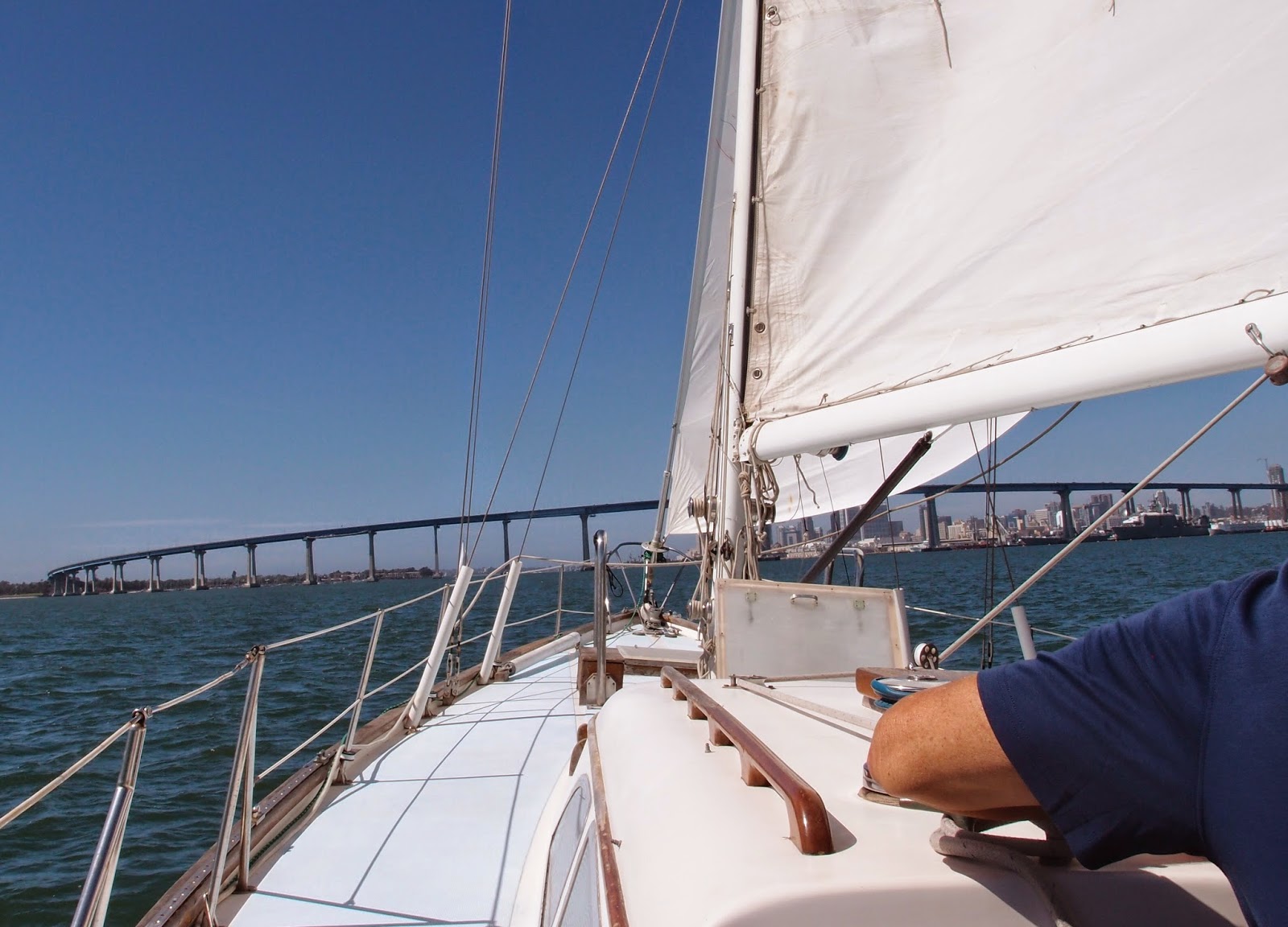
Approaching the Coronado Bridge.

Kevin assigned me the first trick at the helm so I got to work the big sloop upwind under the Coronado Bridge and past downtown. Kevin and Blair kept up a discussion on sailing priorities. It ended with the decision that you could be stupid as long as you didn't make the boat and her crew look stupid. I'm proud to say that, while I wasn't a great helmsman, at least I didn't make the boat and crew look stupid.
The Star of India with the San Diego skyline in the background.

There was plenty to see on San Diego Bay. Beautiful boats and ships, from aircraft carriers and the square-rigged Star of India to other boats sailing on the bay, all held my attention. We even sailed past a Columbia 43 on her mooring. The San Diego skyline and waterfront was beautiful from the water with big buildings, a waterfront park with an enormous statue of a sailor kissing a nurse. Past downtown the buildings and commercial waterfront gave way to moored yachts and Navy vessels.
Virginia at the helm.

At the mouth of the bay we turned back. Kevin assigned Virginia the wheel and went below to make sandwiches with Lisa. Just then, pod of dolphins surfaced within a few feet of the boat. I was the first to spot them and, thinking the San Diego folks saw this all the time, I tried to be casual when I announced their appearance. Lisa was out of the cabin like a shot. "We never see dolphins in the bay!"  she said, "only sometimes in the ocean."
Lisa and Kevin making sandwiches down below in Skylark.

Virginia had the most challenging trick at the wheel sailing downwind. Sometimes the course dictated that she sail dead downwind with the sails wing-and-wing. Blair sometimes served as a human whisker pole until he got bored. We returned to Fiddler's Cove Marina when the sun was low on the horizon. Kevin is a great teacher and we learned a lot about sailing and docking the boat and the best way to fold sails at the dock.

Skylark is a beautiful boat and Kevin has her dialed in for sure. We plan on staying in San Diego Bay for about a month this fall. I'm eager to get to know Kevin, his family and bay better.

On the way back to our hotel, every comment Virginia and I made about the day ended with "wasn't that great!"

We spent the next day at Disneyland We were in line before 8 a.m. staying nearly to the midnight closing. Lest you think we have amazing endurance, I must admit we went back to our hotel for a two-hour mid-day nap.

Thursday was Minney's Yacht Surplus day. We found a very crispy 135-percent genoa and a like-new storm staysail. I couldn't resist the symmetrical spinnaker made for a Columbia 43. It was old, but in perfect shape. We were hoping to buy an asymmetrical cruising spinnaker, but they didn't have one the right size for our boat at the time. I also found a winch that fit the base of the missing winch on our mast. We combed the store and found a few other needed items. It would have been easy to go nuts; the store really has a lot of great stuff at good prices.

I surprised myself because I was anxious to the point of stomach upset over the transactions. (We had a couple sails and a winch to trade in addition to our purchases.) I needn't have worried, Mr. Minney and his three crew members were friendly, patient and helpful. We felt good about the whole experience, which took the better part of a day.

While at Minney's, we also picked up a mainsail and genoa for Harry James, who is restoring a Columbia 38 in the Napa Valley Marina. After a quick visit and overnight stay with a cousin in the Bay Area, we met Harry in the flesh after years of reading each other's postings about boat restoration.

Harry's boat, Sheer, on the hard at the Napa Valley Marina.
Harry has long been an admirer of the Columbia 38 and finally bought one three years ago with the intent of restoring it over one winter. As I said, that was three years ago. But the work Harry has accomplished is top notch and the boat, Sheer, is a beauty. You can read about his adventures here. His plan is to truck the boat to Port Townsend this summer, do the final commissioning there and then sail it home to Alaska.

After leaving Harry, we wound our way to Highway 101 through the Napa Valley wine country. We decided to take the long way home and see the redwoods stopping the night at Eureka. The next day we checked out marinas at Eureka, Crescent City and Brookings for future reference.

It was a great trip with a great traveling companion. The experience made us look forward with even more enthusiasm to when we will be traveling full time on our sailboat.

Tuesday, January 20, 2015

2014's accomplishments for the Oceanus crew

Hauling out Oceanus was only one of a list of accomplishments in 2014.
2014 was a seminal year for Virginia and me. We made several major steps toward our goal of cruising full time. Last year left us exhausted, but elated. Here's a list to buoy us up and to inform our readers.

Sold our house

Our house was a very very very fine house. We don't miss it.
Leaving the house we lived in for 11 years and getting rid of a lifetime of stuff was the hardest thing we did last year. Maybe in the last 10 years. We were pretty excited when we got a near full-price offer less than a week after we put it on the market in early summer. The excitement faded quickly when the buyer's agent fired off the first of nine adversarial revisions to the offer. The deal almost collapsed several times until finally closing more than four months after we put the house on the market.

Even though we loved our 1400-square-foot house, it was clearly too big. "The only thing I miss is my bathtub and washer and dryer," Virginia said.

Getting rid of our stuff

We are not hoarders by anyone's definition. But still we accumulated a small mountain of stuff. Paring it down to what fits in our Columbia 43 was just plain hard work. We sold tools, wood and excess boat stuff on Craig's List and on Ebay. Our kids rented a large truck and hauled away tables, chairs, beds, pots and pans.

With each trip to the dump or truckload of donations to the thrift store we felt lighter and more free. In the months since we haven't missed any of it.

Hauling out

Sanding down to the original gelcoat.
I hoped the haulout would take only two weeks. Boy, was I naive! It took almost seven. But the haulout was worth the effort, we:
  • sandblasted the bottom and the keel taking off about six layers of old bottom paint;
  • sanded, faired with epoxy the keel and bottom;
  • painted three coats of epoxy barrier coats on the bottom and keel;
  • painted two coats of Trinidad hard bottom paint;
  • removed four through hulls and repaired the hull with epoxy and lots of fiberglass;
  • installed three new through hulls;
  • replaced two old through hulls;
  • unstepped the mast and rewired it as well as taking apart all the rigging and inspecting it;
  • removed an old transducer and replaced with a new one;
  • removed rust and painted the mast step;
  • made rigging improvements to the mast;
  • sealed deck with epoxy around mast partners;
  • removed and replaced the cutlass bearing;
  • more than doubled the capacity of the cockpit drains
  • and the most noticeable improvement -- we spent days and days sanding fairing and sanding some more before having the topsides professionally painted with the AwlCraft 2000.
It was the most physically demanding work we've done in a long time. We literally worked our butts off: we lost weight even eating almost exclusively fast foot for the entire haulout. We called it the boatyard workout. And it was every day, all day for both of us.

Toward the end of the haulout it was tough to haul our tired selves out of bed. "This is like the movie Groundhog Day," Virginia complained, "the same hell every day. Sanding and fairing and sanding some more."

It was dangerous too. Oceanus's deck was 12 feet off the ground and we made dozens of trips up and down the ladder each day. We also worked on scaffolding and with power tools. To make things even more scary we had no health insurance because we both ...

Quit our jobs

It was hard leaving a job I enjoyed and which provided a regular paycheck. It felt like stepping off into the abyss. I miss many things about the job, especially seeing my many friends.

Virginia resigned as a full-time nurse, but still works per-diem at the hospital, picking up about three 12-hour shifts a month. She is something of a minor celebrity when she returns. Her co-workers introduce her to patients as the nurse who lives on a sailboat and is about to sail away.

Oceanus leaves the dock under her own power

Oceanus heads down the river after her haulout. For 12 years she didn't leave her slip.
For most boats this wouldn't be a big deal, but Oceanus hadn't left her slip, except with the help of a tugboat, for more than 12 years. When a previous owner trucked her to Oregon from California he launched her at the Toledo Boatyard and found the engine didn't work. So he hired a tug to tow her down the river to Newport where she stayed in her slip for 12 years.

One of the things Jason, the owner we bought her from, did was rebuild her Perkins 4-108. But several engine issues remained when we bought her, including a leaking raw water pump and a prop that was the wrong size. Jason helped me replace the water pump and, after two trips to Astoria and three attempts by a professional diver, we installed the proper propeller.

Selling Ravn


I sold my beloved faering in 2014.
I suppose I should have included this in our second section, but Ravn deserves special mention. I wanted to build a faering for more than a decade and in 2010 finally finished a 19-foot version designed by Atkin. Before our lives changed, it was to be my last boat. I even joked that my family could use it to give me a Viking funeral when I died.

I loved that boat and poured three years of hard work and the finest wood I could find into building her. She was and is a head turner and won the People's Choice Award at the 2011 Toledo Wooden Boat Show. So selling her was a big deal to me. Luckily I found great new owners for her in Paul and Maryann. It helps that they are good friends and love the boat almost as much as me.

Finishing the head

Virginia gives a final coat of paint to the head.
The most unfinished space in the boat when we purchased her was the head. It was wonderful to build it just the way we wanted it, but it was a lot of work too. It turned out great with an AirHead composting head and a real bathtub.

Bimini and two enclosures

Virginia used the first enclosure, made from Sunbrella View, as a pattern for one made from clear vinyl. 
Virginia's skillfulness and ingenuity never ceases to amaze me. With the help of a local canvas guy, she designed and then he fabricated a stainless steel tubing frame for the bimini. Then she sewed the canvas for it, including a small window so you can see the masthead fly from the helm.

During the haulout (while the boat was in the paint tent and out of the wind) she patterned an enclosure. Once the boat was back in the slip, she sewed a warm-weather enclosure out of Sunbrella View fabric. Then she used that as a final pattern to sew an enclosure with clear vinyl windows for rainy, cold Northwest winters. Since we moved aboard, we are thankful for it every day for the enclosure.

Cabin sole

Varnished teak on the saloon sole gives way to paint with non-skid beads in the rest of the boat.
The plywood cabin sole of the boat was strong, but ugly. We considered several options, but in the end we replaced the ugly plywood in the main saloon with beautiful marine-grade teak plywood and varnished it. In the rest of the boat we cut access hatches to every section of the bilge, then faired, sanded and Virginia painted it. It looks good and is easy to care for.

Painted deck and non-skid

Virginia primes the deck for the first coat of non-skid.
Another huge project Virginia did almost singlehanded was stripping the old paint from the decks of Oceanus and repainting. The decks were repainted several times over the years filling the weave of the original non-skid pattern and making it unsafe. The decks also just looked ugly!

Virginia spent countless hours on her knees using Citrus Strip and a wire brush to prep the decks for painting. Then she did most the painting herself. I only helped with the tipping of the polyurethane paint in the water channels that border the non-skid sections.

Other projects

Oceanus never had curtains until Virginia sewed them using Sunbrella and a track from Sailrite.
We finished several other projects including more wiring, a real AC panel, plumbing projects, a 600-amp house battery bank and a 60-amp Sterling smart charger for the house battery bank and engine battery. I also rebuilt three more hatches and installed a freezer. Virginia sewed curtains for the main cabin. I will highlight several other projects in future posts.

Oceanus received notice in the media being featured in Three Sheets Northwest and named an honorary Columbia 50.

Adjusting our plans

As the haulout stretched into late October it became painfully clear to us that we were not going to sail south in 2014. The weather window slammed shut just days after we relaunched the boat. We also have several projects that need finishing before Oceanus is ready for blue water.

While we really wanted to celebrate last Christmas in the Sea of Cortez, moving our departure date forward has its advantages. One is that we will be around when our eighth grandchild is born in early May.

Another is the relief we felt when the deadline pressure was off. We now will have time to sail north and do our shakedown cruise in the familiar waters of San Juan Islands and Puget Sound. We will then sail south and take our time exploring the Channel Islands and other places in California before going to Mexico in the late fall.


Sunday, May 4, 2014

Oceanus Named an Honorary Columbia 50

Columbia 50, Hermie, homeport Rowayton, Connecticut, shows her racing style in 2010. In that year she won the NYYC Cygnet Cup with three firsts and two seconds as well as the "Lobster Run" from Stonington, Connecticut to Boothbay Harbor, Maine with a family crew.
I'm going to cast aside any false modesty and just tell you that Oceanus is an honorary Columbia 50. I was surprised, pleased and proud when Kevin Reilly made Oceanus part of the Columbia 50 Owners Group. I've written before about Kevin and his wonderful web site celebrating Columbia 50s.

There's a lot to like about Columbia 50s and Kevin should know -- he's owned two of them. Cruising World recently named the Columbia 50 one of the best production sailboats of all time. The boat certainly inspires a dedicated group of owners who lavish attention (and boat bucks) on the old girls. The boats Kevin features on his site are sailed often, well maintained and upgraded.

Little sister, Columbia 43.

Big sister, Columbia 50.
Columbia 43s and 50s are more alike than most sailors think. Besides the obvious -- same designer, flush deck and small gun-turret deck house -- they share many other features. Tripp designed several cabin layouts for the 50, the most popular of which is nearly identical to the 43 cabin arrangement. They both have balanced spade rudders and large fin keel. The beam and draft is about the same and there is only about a foot difference in the waterline length.

Columbia 50
Columbia 43 Mark 1
LOA
50 feet
43.25 feet
LWL
33.25 feet
32 feet
Beam
12.03 feet
12.33 feet
Draft
6.52 feet
6.92 feet
Displacement
32,000 pounds
18,900 pounds
Ballast
14,600 pounds
9,500 pounds
Ballast to Displacement Ratio
45.63%
50.26%
Sail Area
979 square feet
806 square feet
Sail Area to Displacement Ratio
15.61
18.24
Displacement/Length
388.62
257.46
Number Built
62
153 (all three Marks)
PHRF Handicap
102
102
 Designer
 William Tripp, Jr.
William Tripp, Jr. 

The biggest difference is not the length, but in how much these two sisters weigh. A 50 is half again as heavy as a 43. The 43, at the time it was built, was considered an ultra-light racer. Now she would be a heavyweight compared to today's ultra lights. In her day, however, she was a game changer and a very competitive boat.

Both boats have an impressive racing record.
Simoon shows her racing style in 1967.
The Columbia 50 hit the race scene about 1967. That year Simoon, won her class of 24 in the Transpac and come in second overall. She was also first in class in the Newport to Ensenada Yacht Race, which was the largest ocean sailboat race in the world.

In 1973, a Columbia 43, Encore, won the Transpac Class B. A few years earlier, another 43, Blue Norther, was first overall in the ocean racing class in the Newport-Ensenada race.

Both 50s and 43s are actively raced today. On his website, Kevin documents several great examples of Columbia 50s that are still actively raced as the fleet enters its 50th year.

Stumppy J, a Columbia 43 Mark III, heads for the finish line in the 2013 Transpac.
Columbia 43s are still competitive on the race course as well, exemplified by Stumppy J, a Columbia 43 Mark III, making a good showing in the 2013 Transpac. In the same race, the 83-year-old yacht Dorade, was the overall winner on corrected time. Older yachts being seriously campaigned in big-time ocean races is an exciting trend for classic sailboat lovers. The new Columbia Yacht Corporation is helping the trend by offering a completely refurbished Columbia 50 with a new boat warranty. Let's hope their next project will be a Columbia 43!

The pictures on Kevin's web site are serious eye candy, as the two I borrowed for this article attest. I spend a lot of time just looking at them. It's an honor for Oceanus to be among them. My ideal cruising buddy boat would be a friendly couple or family in a Columbia 50. Sitting in Oceanus's cockpit and gazing across a beautiful anchorage at a sleek Columbia 50... views don't get much better than that.

Monday, September 9, 2013

Great new web site for Columbia 50s

Columbia 50
Kevin Reilly, owner of the  Columbia 50 Skylark, built a wonderful new web site about that beautiful Tripp design. I heard about it through the Columbia Sailing Yachts discussion group, of which we are both members. (Also a great resource for Columbia Yacht owners.)

Of all the Columbia sailboats I think the Columbia 50 is the most similar to the Columbia 43. They both have the same designer, the dimensions are suspiciously similar (the beam is the same on both, the waterline length is only one foot shorter on the 43 than the 50, the draft is nearly the same and the standard interior layout is nearly the same).

The boats were so similar, in fact, that Columbia Yachts could use the entire deck, including the house and the cockpit, from a C-50 on the C-43 hull number one . They just had to trim around the edges.
Columbia 50

Columbia 43

Here's wishing Kevin well on his new endeavor. Be sure and check it out.

Sunday, April 28, 2013

Alcyone -- Hull number one


Alcyone under sail. (From the Columbia Yachts Owner's web site.)
I needed a break from not working on my boat yesterday so I ambled to the little marina store for a Pepsi. I did a double take when I looked at G Dock and saw another Columbia. No, not just a Columbia, a Columbia 43 (building excitement)! No, not just any Columbia 43... Alcyone -- the first Columbia 43! And it's in a permanent slip too, not a transient one.
Alycone in her new berth in Newport, Oregon. 

Check out that deck house! The hull-to-deck joint is different as is the toe rail and other features of the boat. 

Alcyone is distinctive because she was built with a cut down Columbia 50 deck on her. She really looks different, in a custom, cool way. It looks like she has a few inches less freeboard as well. Putting a Columbia 50 deck on the Columbia 43 isn't as weird as it sounds. Both boats have the same maximum beam (12 feet 3 inches) and the 50's waterline is only a foot more than the 43. Of course both boats were designed by Bill Tripp. I wonder how he felt about hull number one?

In Greek myth, Alcyone was the daughter of Aeolus, the Greek god of the wind. A very cool name for a sailboat.
The cockpit is different from other Columbia 43s with all-wood combings and a separate well for the helmsman.

I can hardly wait to talk to Dave and Betsy, the owners. I'm hoping for a tour down below and some good stories. I've never seen another Columbia 43 and I didn't see mine before she was modified so extensively. It's interesting that there are two Columbia 43s in the same marina and both are unusual.