Sunday, June 30, 2013

Oil and varnish mix

by Brandon
A couple of coats of the oil-varnish mixture reveals the grain and figure on the African mahogany.
A friend of mine was reading this blog and asked me how I made my oil-varnish mix. The oil-varnish mixture I use is one part linseed oil, one part spar varnish and one part mineral spirits. You can substitute turpentine for the mineral spirits, but it has a stronger smell. You can also substitute tung oil for linseed oil. The advantage to tung oil is that it doesn't darken the wood as much as linseed oil. Most of the time I'm trying for a dark look to the wood so I usually don't use tung oil. Boiled linseed oil is not as expensive as tung oil. Cheap spar varnish seems to work as well as the expensive stuff.

I put the oil on thick with a rag or a small chunk of synthetic steel wool (the gray color is my favorite) and let it soak into the wood for 20 minutes to an hour and then I buff off any that hasn't soaked in with a lint-free rag, usually an old towel or t-shirt. It takes five to seven coats to get a good sheen on the wood. You should let it dry 24 hours between coats.
 
The advantages are:
  • it's easy to apply;
  • you can do it in a dusty shop or boat;
  • it feeds the wood;
  • it makes the grain and wood figure pop;
  • when you touch it you feel smooth wood, not plastic finish,
  • and it very easy to repair.

I often do a few coats of the oil-varnish mixture and then a couple coats of spar varnish. It makes a great base coat for varnish (shellac too). I think it seals the wood so water doesn't get under the varnish as easy.

When the finish gets a little dull or looks worn or scratched I just get out my little bottle of oil-varnish mix and a small hunk of gray synthetic steel wool and in no time it looks great again. This even works well when I've put a couple of coats of spar varnish over the oil-varnish mixture.

One more variation that I've heard about is adding about 10 percent of pine tar or Stockholm tar to the mixture. I'd never use this inside, but I sure would outside on a boat where you want a workboat finish. I'd do it just because Stockholm tar smells so good. My guess is that adding the tar would greatly slow down the drying time. It may stay tacky for a long time.

Monday, June 17, 2013

A Pile of Cushions

I always felt  that I wasn't contributing as much to the boat project as Brandon, so I was excited to be able to start sewing the many canvas and upholstery jobs that need to be done. There are a total of twelve cushions in the boat. all but one are in the main salon.

I foolishly thought that amounted to only a few hours worth of sewing. Boy was I wrong!

My friend Joi C. Hess volunteered -- actually, she insisted -- she help me with covering the mountain of foam stacked in my guest bedroom. She claims to enjoy sewing cushions and making piping. She calls this  "Therapeutic Sewing Sessions."

When Brandon and I chose our fabric we were temped to get what was on sale, but in the end we decided to get our favorite Sunbrella upholstery fabric. We are very glad we did. The Sailrite site helped us select fabrics that looked good together. 
Dueling sewing machines.

I don't know if I could have done them so well without her help. She happily sewed on the pieces that had the piping then handed them to me for the next step. After four sewing sessions that lasted about eight hours each, they are all done!

The cushions arranged as they will be in the main salon.

Joi took home fabric about three weeks ago and is making pillows. Three of these are on actual pillow forms, the rest of them will have zippers and be stuffed with extra blankets and throws. Joi brought us the first three pillows (the ones on the pillow forms) and I have never seen such exotic pillows in my life! I question Joi's state of mental health after this.

Joi's pillow masterpieces.

While Joi may think these sessions were therapeutic, I didn't. Now I need some heavy-duty Therapeutic Knitting Sessions.

Tuesday, May 21, 2013

Fiddles, cushions and other updates

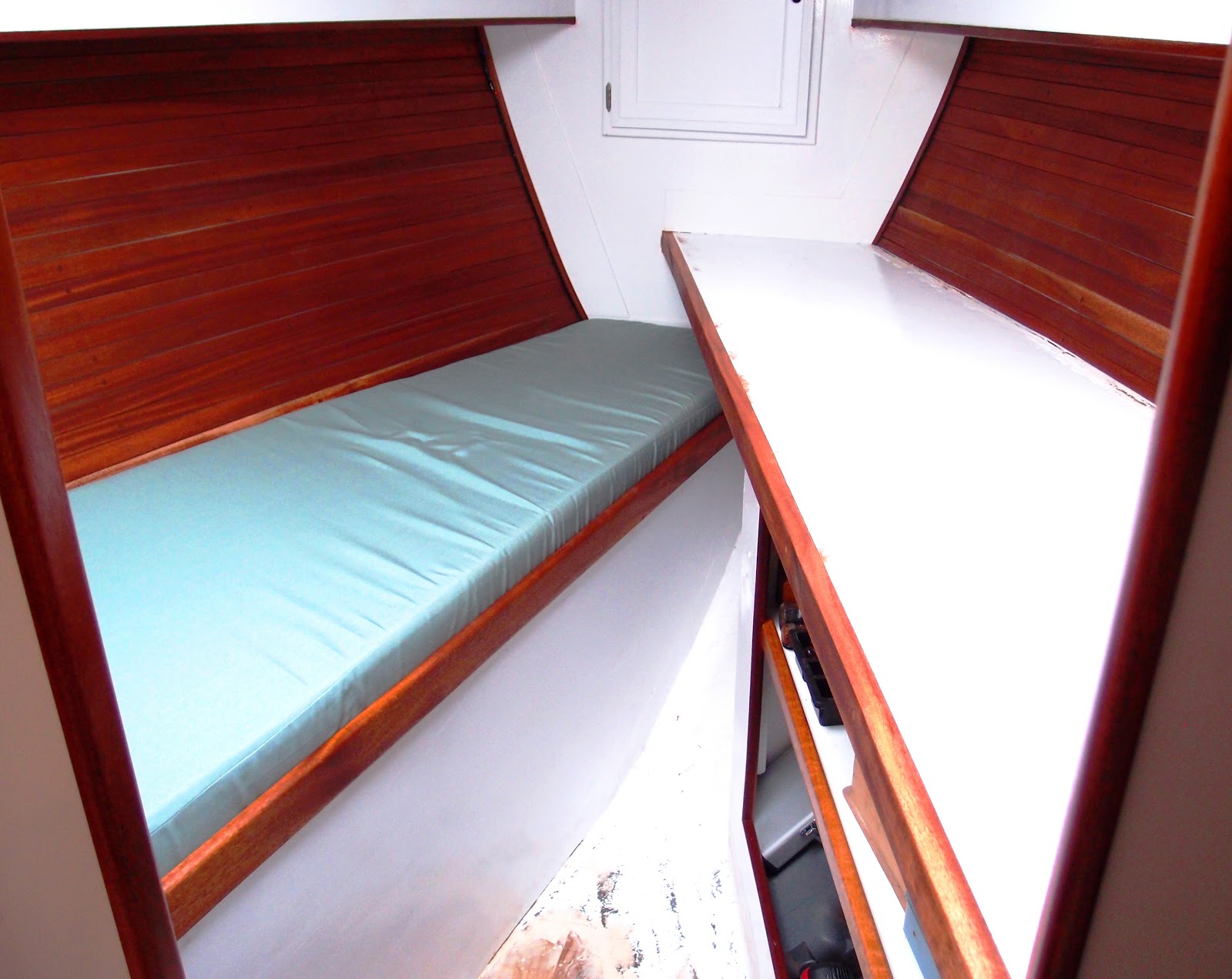
A cushion for the forward bunk, fiddles and wood trim make the forepeak look nearly finished.
Virginia and I have advanced on two fronts this month. I continue to work on wood trim and fiddles while my wife and her friend sew new cushions.

Virginia and I made paper patterns for the bunks and settees and rough cut the foam for the cushions. We then took the rough-cut foam to the boat for the final fitting. For that we used our trusty electric carving knife. I heard an electric carving knife was The Tool for cutting foam but I was skeptical until I actually tried it out. It works pretty slick; much better than I thought.

I really like the color of the cushion cover. The pillow was a find at Ikea. I had to buy it because in the top left corner it says "Oceanus."

Once we knew the foam fit, Virginia and her friend, Joy, went to work cutting out fabric and sewing the covers. The original plan was to sew zippers in one side of the cover. After the first one, Virginia decided it would be easier and less expensive to whip stitch them closed instead. They look very professional.

Joy took the left-over fabric home to make pillows. Some of them will have zippers and nothing inside them so we can use them to store our bedding.

Most of the wood for the teak fiddles in the main cabin came from an old door.
With the cushions nearly finished, I got busy on the fiddles that will help hold them in place. In the main cabin I used teak because I had three pre-made rounded corners that I wanted to use and they were made of teak. Teak costs about $27 a board foot. The African mahogany I've been using in the rest of the boat I can buy for $3.50 a board foot. Needless to say I only use teak when I must.

I was able to get most of the fiddles made from pieces of an old teak door from the old interior. Two longer pieces I had in the shop. They were gifts from my old carving teacher when I helped her move about 10 years ago. Teak was her favorite carving wood. It is amazing wood to work with hand tools.

I'm finishing up some other projects as well, like hanging the gimbled oven and making more storage spaces. During the dry weather earlier this month we put a couple of coats of varnish on the outside teak.

Sometimes I look at my to-do list and have to lie down. Now I have a nice cushion, I'm much more comfortable.

Wednesday, May 1, 2013

Hull number one: Part two, the inside story

David and Betsy aboard Alcyone, which they have owned for 12 years.
David and Betsy invited me aboard Alcyone for a look at her inside. What a beauty!

The boat has the standard layout, but the joinery is a cut above what you would expect in a production boat. Most of the fiberglass pan is clad in teak veneer and there are many extra cabinets and other special features.

The story goes that the first hull was sold to the commodore of the Marina del Rey Yacht Club. He was friends with the Columbia Yachts president so when he said he wanted the new 43 hull with a Columbia 50 deck, that's what he got.

It is a wonderful and unique boat with many custom features beautifully executed. David and Betsy have owned her for 12 years. Alcyone couldn't have better stewards.
Another look at the outside.

Sunday, April 28, 2013

Alcyone -- Hull number one


Alcyone under sail. (From the Columbia Yachts Owner's web site.)
I needed a break from not working on my boat yesterday so I ambled to the little marina store for a Pepsi. I did a double take when I looked at G Dock and saw another Columbia. No, not just a Columbia, a Columbia 43 (building excitement)! No, not just any Columbia 43... Alcyone -- the first Columbia 43! And it's in a permanent slip too, not a transient one.
Alycone in her new berth in Newport, Oregon. 

Check out that deck house! The hull-to-deck joint is different as is the toe rail and other features of the boat. 

Alcyone is distinctive because she was built with a cut down Columbia 50 deck on her. She really looks different, in a custom, cool way. It looks like she has a few inches less freeboard as well. Putting a Columbia 50 deck on the Columbia 43 isn't as weird as it sounds. Both boats have the same maximum beam (12 feet 3 inches) and the 50's waterline is only a foot more than the 43. Of course both boats were designed by Bill Tripp. I wonder how he felt about hull number one?

In Greek myth, Alcyone was the daughter of Aeolus, the Greek god of the wind. A very cool name for a sailboat.
The cockpit is different from other Columbia 43s with all-wood combings and a separate well for the helmsman.

I can hardly wait to talk to Dave and Betsy, the owners. I'm hoping for a tour down below and some good stories. I've never seen another Columbia 43 and I didn't see mine before she was modified so extensively. It's interesting that there are two Columbia 43s in the same marina and both are unusual.

Tuesday, April 23, 2013

LEDs for Earth Day

An original dome light and an old German-made reading lamp are updated withe new LED lights.
Earth Day found my son-in-law and I rewiring old brass lighting fixtures and replacing the incandescent bulbs with LEDs. The original dome lights were little more than lumps of corrosion in one of the many boxes of gear that came with Oceanus. My wife and I spent several evenings polishing them down to the shine. We tried every commercially available potion to little effect. As a last resort we used a dollop of distilled vinegar on a fist-full of salt and were finally able - with a lot of elbow grease - to cut through the verdigris.

The beautiful diamond-patterned glass lenses came sparkling clean in the dishwasher. We were able to save most of the sockets, but all the switches were toast. By the time we replaced switches and added LED lights we were at or above the price of new dome lights. These, however, were part of the original boat and we felt it was important to save them. Besides, they are good-looking and classics.

In addition to the five original dome lights, we added two German-made reading lamps from about the same era we found at a yacht equipment resale store. They received LEDs as well. New strip LEDs will go under the cabinets in the galley and in the head. We will more than double the light sources in Oceanus from her original five dome lights. And the LEDs promise to be brighter too.

The LEDs are expensive to purchase, but with their long life-span (about 20,000 hours) they should eventually pay for themselves. Their real benefit on a sailboat, however, is how energy-efficient they are. They draw less than 5 percent of the energy of the incandescent bulbs they replace and do it without adding heat, which should be a boon in the tropics.

One of the attractions for me of cruising in a sailboat is being somewhat energy independent. Living off the grid and lowering my carbon footprint is a goal I've had for some time. I hope the LEDs will help me get there. Happy Earth Day.

Tuesday, April 2, 2013

An accent chair for the library

The slip cover was a perfect fit on the first try.
Virginia spotted this chair even before we signed the papers on Oceanus. "It would be perfect for sitting and knitting," she said. It was half off the day we spotted it, so, uncharacteristically, we made an impulse buy.

The original cover zips off and on.
Even though it is made to be hauled around -- in the cockpit, on deck, on the dock -- we figure the perfect place for the chair is next to the hanging locker across from our bunk. I installed a bookshelf there and we've taken to calling it the "library." Every proper yacht should have a library with a comfy reading (excuse me) knitting chair. Right?

The dark blue cover was fairly good looking, but it didn't match the family of fabrics we will use on the boat. Virginia solved this by using the old cover as a pattern and sewing a new, fitted slip
cover.
The library chair in it's rightful place.