Saturday, January 25, 2014

Original advertisements for the Columbia 43

During my weekly Google search for all things Columbia 43, I came across an Ebay seller with two original Columbia 43 ads up for auction. I won the bid on both ads. They are pretty cool and it made a quick blog post.

The boat featured in the photos for the ad is Blue Norther, the eleventh C-43 built. Blue Norther is also the boat that starred as the boat Amanda in the second season of the ABC series Revenge.
From the code in the information-request box I think this ad was published in 1970.
I'm not sure which magazine this first ad comes from. The page on the back of the ad is another full-page ad for Mercury inboard/outboards.The code in the reply box makes it appear that this ad came out in 1970. The first ad is a single, full-page ad that trumpets the C-43 winning the world's largest ocean race, the Newport to Ensenada Yacht Race.

This is the high-folio page of a two-page ad in Yachting magazine. I'm not sure of the date, but the code in the response box makes me think it was 1970.
The next ad is a double truck, two full-page ads on facing pages. The headline reads, "Meet the Magnificent Aggressor, Columbia 43... $29,995!"

The interesting part of the second ad reads: "This is undoubtedly one of the most aggressively designed ocean racers ever created by famed naval architect, Bill Tripp.... Classified as light-displacement, the Columbia 43 exhibits the highest sail-area-to-wetted-surface ratio of any of his designs. The rig towers 54 feet above the deck. Powerful headsails are permitted with a "J" measurement of 17.8'.

"And there are some highly potent design dynamics below the waterline as well. The Columbia 43 has a noticeably long waterline...32'8". By carrying the lateral distribution of displacement well into both the bow and stern sections, Tripp has simulated the wave system produced by an even longer waterline. When you lengthen the waterline, you increase the speed. This high prismatic coefficient* story is something your competitors will ask you about after the race!

Thirty grand was a lot of money back in 1970. You could buy a nice house in Seattle for about than half that back then. You could also buy six brand new Corvettes for that price.

More interesting stuff mixed in with the unavoidable copywriter hyperbole. I'll crop out the tablecloth and clean these up later. I was just excited to share them. Eventually I will add a page to the blog with these and scans of the original Columbia 43 owner's manual, which came with the boat.

*Prismatic coefficient (Cp) is the volume (V) divided by Lpp x Ax. It displays the ratio of the immersed volume of the hull to a volume of a prism with equal length to the ship and cross-sectional area equal to the largest underwater section of the hull (midship section). This is used to evaluate the distribution of the volume of the underbody. A low or fine Cp indicates a full mid-section and fine ends, a high or full Cp indicates a boat with fuller ends. Planing hulls and other highspeed hulls tend towards a higher Cp.

Tuesday, January 21, 2014

Two keystone projects in the head

The soaking tub in Oceanus.

I am finally giving some attention to the boat's head. Since we started working on the boat 18 months ago we have used the space that will become the head for storage. My excuse for not working on it last year was that it was dark; no natural light at all. That changed this summer when I installed a new opening hatch. Now I'm left without excuse.

So, after much head scratching (no pun intended), I figured out how to proceed on the two keystone projects that will determine the interior design of the head: the shower/soaking tub and the hanging cabinet.

First, let me acknowledge all you sailboat purists that say a soaking tub has no place on an ocean-going sailboat. You may be right, but hear me out. A space for a dedicated shower stall was always in the plans since revising Oceanus's interior. The tub/shower takes up no more useable space than the dedicated shower would. Since the the space where the shower will be is in a part of the boat that doesn't have enough headroom for me to stand up straight, a place to sit is a good thing. The tub will also be a great place to hang wet foulweather gear. My wife says she can use it to wash clothes on days too cold to do it in the cockpit. It could also be handy when the boat's really rocking and rolling and you need a secure place to quickly stash the stuff that's just crashed to the cabin sole until things quiet down a little.

Finally, and maybe most important, my wife really likes to soak in the tub. While tied up at the dock with unlimited water and electricity, why not? Even if this only happens a couple times a year, may I say again, why not? The shower part of the equation has lost none of its utility and you have an appealing option you can exercise when conditions permit.

In my marina, heck, in every marina, there are boats whose owners paid thousands and even hundreds of thousands of dollars for and they use them only once or twice a year. These are fabulous boats that the owners really love, but they sit idle most of the time. I have a theory about this. I think many owners bought their boats as much for the dream of sailing as the actual experience of sailing. The guy sitting at home a hundred miles inland from his boat experiences some vicarious enjoyment just knowing that he owns an ocean-going sailboat that he could sail to distant ports. (Most likely a fair bit of guilt too for tying up so much of his resources for almost no actual use; but that's another story.) I'm sure that we will experience some vicarious enjoyment of the tub just knowing that we could take a long, hot soak.

After a little searching on the internet, I found what I needed: an RV step tub. They are designed for the space just in front of or just behind a wheel well with a seat over the wheel. This arrangement works well for the space I have because the seat will go over the curve in the hull. With shipping, it came to just under $200. I was happy with the general appearance and sturdiness of the tub. The sides oil-canned a little, but I had a plan for fixing that.

Since this is terra incognita for me, I called on my friend Doryman to help. He built a similar tub in his large sailing dory and he has a great brain for fitting things.

We modified the tub slightly by cutting off half of the front ledge and ground some of the surfaces to which we later epoxied fiberglass cloth. Once we cut down the rudimentary cabinet to make room for the tub, we lined the space with pink foam insulation, set the tub in place and used waterproof construction adhesive and a couple of temporary screws to hold it in place. I also sprayed in some expanding foam to fill any voids.

Insulation around the tub.
... and more insulation.

The next day I removed the screws and added more foam board and expanding foam so the entire tub has at least two inches of foam. I built up the sides of the tub in the front. I glued more pink foam board to the bare fiberglass hull.
Two braces hold in place a wooden frame at the edge of the enclosure while the epoxy kicks. Three layers of fiberglass cloth cover the foam against the side of the hull.
It took several sessions with Doryman and I fiberglassing the enclosure, but I'm really happy with the result. The backrest is especially comfortable and has a nice angle. The whole thing is insulated better than most iceboxes. Part of this is to avoid any dead spaces with no access, but mostly it's to keep things comfortable. I hate cold surfaces when I'm wet and naked.

There is still a lot of sanding and fairing yet to do before Virginia paints. I think we will use the same white paint we use on the outside of the boat (Brightsides). That should be plenty durable.

The other project is a cabinet that will surround the hanging knee to which the chainplate for the port shroud is bolted. I wanted plenty of space to get at the chainplate for inspection and maintenance. It also ties the hanging knee more securely into the hull.
A brace presses foam insulation in one compartment of the cabinet, which is fiberglassed to the sides of the hull and the overhead. The large compartment, which will hold towels, will also be insulated with foam. The foam will be covered with fiberglass cloth. I don't want condensation to make our towels damp.
Virginia plans to put towels in the big space forward of the chainplate. The two smaller compartments will most likely hold big toiletry items.

With the shower and the cabinet in place, I can design the medicine cabinet, which will have a mirror in the door. I can also build the countertop and install the sink and faucet for manual foot pump.
Virginia sewing the new bimini.
Other project updates: Virginia is sewing the finishing touches on the bimini. We did a trial fitting over the weekend and it looks great. One of the things we checked was the position of the window to make sure we can see the masthead. Expect a full post on that soon.
Pillow art made by Joi Hess.
Our great friend Joi Hess, presented us with more pillows. These are empty with zippers in them so we can store bedding, winter coats and other soft items. As with her other three throw pillows, these are truly works of art.


Tuesday, December 24, 2013

Merry Christmas

My wife and I love Christmas lights. Since you can see our boat from the Yaquina Bay Bridge and a local restaurant, we felt it was our obligation to decorate Oceanus with lights. The superwide lens and the panorama feature makes the boat look fat.
Merry Christmas my faithful blog readers! I hope both of you have a very merry one.

I promise a full report of my activities soon. I've been working on access hatches in the sole of the boat and installing a bathtub. Yes, you eyes did not deceive you, Oceanus will have a soaking tub that will be super insulated. I know it sounds kinda impractical, but the more I think about it the more I like it. It will have other uses as well, like washing clothes. More on this later.

Virginia's and my Christmas gift is a new, stainless steel bimini frame. It's installed and Dean did a super job. More on this later too.

Thursday, December 12, 2013

Destiny: a Unique Columbia 43 With a Rich History

Destiny, a 1971 Columbia 43, is a well-traveled boat.
Destiny, a 1971 Columbia 43, was the live-aboard home for Gerry Waterson for more than a decade. He cruised her to Maine, Nova Scotia, England, the Jersey Isles, Canary Islands, Azores, Windward and Leeward Islands, Pueto Rico, Dominican Republic, Virgin Islands, Bahamas, Turks and Caicos, Bermuda, Florida and the Chesapeake Bay.

He and his wife bought the boat when he was 31 and she was 29 after seeing her at the Annapolis Boat Show. "I fell in love with her lines immediately," Gerry said. "I could see she would be a great cruising boat."

He asked Columbia to build his boat with a shallow-draft keel. "I may have been the first to use the smaller keel," he said. "I told Columbia that I wanted a five-foot one instead of the seven-foot one or the centerboard model. I knew reef avoidance was a major consideration where I would be traveling. I drew a diagram of a keel roughly based on the Star class boats with a large streamlined  bubble at the bottom and Columbia made it. I'm not sure if they offered it to others; they said they might. If so, I was the first to have one. If any readers had that keel configuration, I'd like to know."

Gerry said he used to race informally against a Columbia 43 with the deep-draft keel and didn't notice any difference in performance.

Gerry paid around $30,000 for his new boat back in 1971 with Atomic 4 gas engine and special-made five-foot keel. If you run that through the Inflation Calculator it comes out to be about $173,000. The cost of a new Corvette was about $5,000 in 1971.
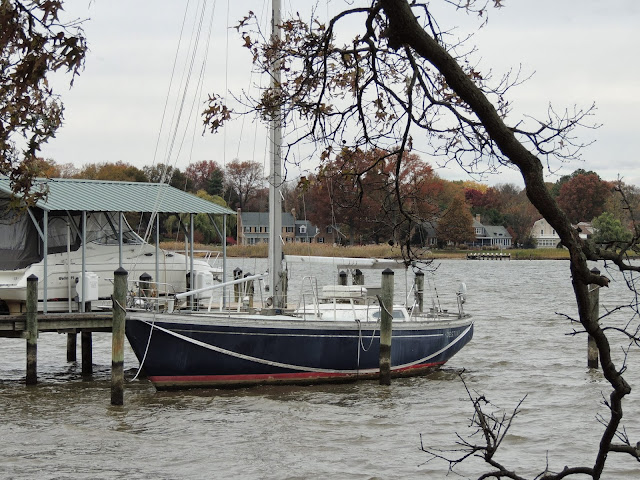
Destiny is docked behind Gerry's home.
That was just the beginning of the changes Gerry made to Destiny. After taking possession in August 1971, he replaced the gasoline engine with a Westerbeke diesel, replaced the alcohol stove/oven with a stainless steel propane one, added mast steps, replaced the fuel and water tanks with bladder types and added some more in other compartments of the vessel and added a wind-vane style self steering mechanism.

After getting the boat, Gerry and his wife spent every weekend and vacations on the boat, including during cold weather. They were living in Philadelphia at the time where he was Director of Computing at Rutgers University and she was a physical therapist. They moved aboard full time in 1976 and continued to work on outfitting the boat.

"Our last winter before we left I added a small firebox that burned pea coal and that provided more than enough heat on a freezing night," he said. "We lived and worked in the Philadelphia area while refitting Destiny into a shorthanded vessel, adding self tailing winches, a substantial anchor davit and windlass [to handle the] all chain rode, fanny supports around the mast to facilitate sail changes and life raft support on the cabin top that made for an easy toss into the ocean if need be."

He also added a boom crutch, which served as the front support for an awning that covered the entire cockpit. One last addition was a club jib, "which was great for sailing in high wind conditions since it was not way up at the bow and it was a small sail that could even be furled into a smaller area."

In 1977, before he started cruising full time, Gary gathered some friends to sail from Cape May, New Jersey to Bermuda.

"We didn't have weather forecasting like there is today, but did check as best I could. It's around 600 miles and I thought I could make it in around five days or so," Gerry recalled. "Hurricane force winds developed and we were in a terrible blow. We used double reefed main, reefed club jib and dragged a sea anchor for stability. All of sudden the furling genoa unfurled and the boat went over on the side with the mast touching the water. Then the genoa caught wind on the other side and went to the other side touching water on other side. Before we could all say our last prayers, the genoa ripped to shreds and we were saved. We limped along as the storm abated and tried to determine where we were using sextant (no GPSs in those days) but I couldn't get a great position. We saw very large U.S. Navy ship in distance."

The ship was the cruiser USS Columbus. It came towards Destiny, probably because they saw the shredded sail on the forestay.

"It looked enormous alongside Destiny and we had to speak via megaphone since our radio was out of commission," Gerry continued. "I asked for our position and a bearing to Bermuda."

After sailing for a few days it became clear that either the Navy gave Gerry wrong coordinates or he misheard because the sextant readings didn't jibe with where the Navy said they were. Eventually he got the readings to work out and Destiny limped into Bermuda. "She was a mess with vomit, paper mush and broken items all over."

Gerry said he loved the club jib and never used a roller furling sail again after that experience.
This bow photo showes several modifications Gerry made to his boat, including the bow roller for the anchor.

The harrowing trip to Bermuda didn't dissuade Gerry from his dream of cruising full time. In 1978 he and his wife chucked their jobs and cut the dock lines. He cruised with her for two years. They divorced in 1980.
"She was very excited to do what we did," Gerry said, "but she really did want the white picket fence. I continued my cruising  and then I remarried in 1986."

Next came a house, then a job, then a business. The house required a cedar shingle roof, new bathrooms, new windows, new patios.... "The intervening years went by fast but each year I look out at my dream and shed a silent tear as to what was and what could be," Gerry said.

The other priorities lead to Destiny being ignored. Water damage from deck leaks, a failed hose and defective bilge pump left her with a long to-do list. But Gerry is committed to bringing her back.

"Your work has inspired me to bring Destiny back to life," Gerry said. "It might take me five or 10 years but I've already started the planning. I am fortunate to live near Annapolis, Md., so there are local places to buy all sorts of exotic woods, maybe rebuild the Westerbeke 40 and get some stanchions replaced. I'm 73 so I'll have to work fast."

Monday, December 9, 2013

Boat Work Suspended for Something More Important

Peter Ford on Day Nine, the day you could really tell someone is home.
Virginia and I didn't work on our boat this weekend. There were one hundred things, I'm sure we could have done to move the project along, but we didn't. Instead we drove five hours one way on snowy roads (really rare for the Oregon coast) to see our new grandchild, Peter.

It was worth it. I hardly gave a thought to Oceanus I was so enraptured with this little guy. We were there for days seven, eight and nine of his life. Each day brought new accomplishments. This morning he was looking around and you could really tell the lights are on inside that little fuzzy head.
Grandma and big brother Corban.

Check the hair.

Friday, December 6, 2013

Giving thanks for a son-in-law who's an electrician

Son-in-law Tony strips insulation from some wire in the engine room.
I was super thankful for our son-in-law Tony this Thanksgiving. After feeding him prime rib on Thursday we spent two days doing more (yes, I said more) wiring on the boat. We (and when I say we, I mean Tony wiring, me wringing my hands and trying not to get in the way) wired a couple more lights and three pumps -- the bilge pump, the shower sump pump and the pressure water pump.

The shower sump came with the boat and was really nasty-looking. So while the prime rib was cooking on Thanksgiving I spent more than an hour cleaning up the sump and the 500 gph pump inside. I did most of the cleaning with dish-washing detergent and really hot water, but I had to resort to some 409 cleaner on some ancient, black soap scum. At least I hope it was soap scum. Did I mention that it was really nasty? I got the pump looking almost new.

As you can tell from his sweatshirt, Tony is a proud member of the International Brotherhood of Electrical Workers. Not many yachts, even the really expensive ones, are wired by union electricians. At the bottom of the photo you can see the new pressure water pump.
The next day when we got to the boat we tested the pump and the float switch. Neither of them worked, so we went to Englund Marine, the local marine supply, and replaced them both. The bottom line is that all three pumps are band new. Even if the old pump worked, I'm glad we replaced it.

Tony spent some time making the back of the electrical panel look good. He also installed two new LED lights in the engine room, but didn't have time to connect the wires. Looks like I'll have to wait for the next visit.
Granddaughter Lydia visited her hard-working dad and brought lunch.

"So, what percentage of the wiring is finished," I asked. "Eighty percent?"

"More like 65 percent," he said. Then he started to tick off all of the stuff yet to do: battery bank, charger, inverter, regulator, solar panels..." The list went on long enough for my eyes to glaze over. And I don't even think he mentioned all the electronics we need to install.

Speaking of big boat projects, the installation of the pressure water pump is the first step in plumbing the boat. Well, maybe not the first step: Jason, the previous owner, built in two new 50-gallon water tanks and just before the party I installed the galley sink and faucet. Hooking everything together is what gives me heartburn. Plumbing and I have a long and ugly history.

The thing I have working in my favor is that I've somehow convinced my otherwise intelligent wife that plumbing the boat would be a fun project to do together. "It sounds like doing a puzzle," she said, "I like puzzles."

Fun. Puzzles. I can hardly wait.

Sunday, December 1, 2013

Columbia 43 article in Sailing magazine

Here's a post that I wrote months ago. I don't know why I never posted it. Keith, a neighbor on A Dock, gave me a copy of the Sailing magazine issue the article is in. I love it.

There was a nice article in Sailing magazine about the Columbia 43. Here's the link:
http://www.sailingmagazine.net/boats/6-used-boat-notebook/1287-columbia-43

Here's the comment I wrote about the article:
Thanks, Mr. Liscio, for an excellent article. I purchased a 1971 Columbia 43 in July and I'm continuing a big remodel and refit that the previous owner started. Almost nothing inside the boat is original. The previous owner stripped out everything, including the hull liner the bulkheads! The engine, a Perkins 4-107, which I understand was original to the boat, is newly rebuilt. All new bulkheads and furniture are installed and painted. There's still a lot to do, but the new interior design is perfect for a cruising couple.

I hope to have her in sailing condition by next summer. The comments from current and past owners of the 43 on the sailing characteristics got me very excited. Once she is ready, my wife and I plan to sail our Columbia 43 to Mexico and Polynesia before returning to the Northwest.

I noticed a couple of facts that didn't jibe with what I've read about the boat:
* You say "The MkIII version of the Columbia 43 had its hull lengthened by six inches, a taller mast for more power and a lead-ballasted keel instead of iron" The mast and the keel part are right (the mast is six feet taller on a Mk III), but I think the hull stayed the same length.
* You said gas engines were standard. I think the standard engine was a Perkins 4-107, but some racing enthusiasts pulled the Perkins and put in an Atomic 4 to make the boat lighter.
* Tanks: you said it was 45 gallons of fuel and 35 gallons of water. In my owners manual it says it was 50 gallons of each. (My boat has new water and diesel tanks, 100 for water, 110 for diesel.)

The important thing is that you captured the essence of this wonderful boat. Tripp was a master and created some of the most beautiful boats of the CCA era.

I blog about my boat at: http://hagothlog.blogspot.com/

Thanks again for the good article,
Brandon Ford
SV Oceanus, Newport, Ore.