This blog is about a three-year total refit of Oceanus, our 1971 Columbia 43, turning this classic Bill Tripp racer into a comfortable and fast cruising boat. We left Newport, Ore., in February 2016 and sailed to Southern California and Mexico. We are now in Hawaii and plan to cruise these beautiful islands before returning to the Northwest.
My rigging knife has served me well for more than a quarter century.
A friend asked me yesterday what I thought made a good rigging knife. The question took me back 25 years ago when I was working on the tall ship Lady Washington. I worked in the office pimping the project but I stole out to the shipyard often to talk to the shipwrights and riggers. Ostensibly, it was for information that I could use in the articles and news releases I wrote to promote the Washington State Centennial project, but really it was to learn as much as I could for my own selfish ends.
I was a hopeless fan boy when it came to the riggers. Those guys were just cool! And they carried a knife everywhere, all the time. This knife wasn't like the knives you saw in chandleries that catered to weekend sailors and yachties. This knife was made for serious work. It was almost always in their hands. I looked for one like theirs, but couldn't find anything close, so I had a friend make me one.
Ken Adamson also worked on the Lady Washington at the same time I did. We were friends for some years before. It was he who encouraged me to leave my job at the newspaper to work for the fledgling Grays Harbor Historical Seaport, which was building the Lady Washington.
That's me at the right, in a costume my wife sewed. Ken is the guy with grey hair and glasses in the back row second from the right.
Ken was an all around craftsman. A former high school industrial arts teacher, there weren't many crafts he wasn't familiar with, if not already an expert in. His woodworking skills were legendary in the shipyard. When there was a problem that needed solving Ken was the go-to guy. He also made pots, jewelry and knives in his home studio.
I told Ken of my fruitless quest to find a proper rigger's knife and asked if he would make me one. He watched the riggers closely too and knew just what was needed. I had complete faith in his skills as a craftsman and left the details of the knifemaking to him. Several weeks later he told me my knife was finished and I went to his studio to pick it up.
It was everything I wanted and more. The wood scales were of African kingwood and the handle fit my hand perfectly. The blade had a thick spine to take whacks from a mallet to drive it through rope. Ken ground down the blade to give it a little hollow and bring it to a sharp edge. He crafted, almost inconspicuously, a small eye in the back of the handle to take a lanyard. But perhaps the most elegant feature of the knife was its drop point. It looked just right.
Most "rigging knives" sold at chandleries had a sheep-foot point - maybe end is a better term because a sheep-foot point is not pointy at all. In the sailing ship days when a sailor would come aboard for a cruise he would hand over his knife to the bosun's mate. The bosun's mate would stab the point in the ship's rail, break it off and hand it back to the sailor. Fights in the fo'c's'le were less lethal with pointless knives.
Unfortunately, these disabled knives became associated with sailor's knives and the tradition created a whole crop of knives without a point. Having a point on a rigging knife is a handy thing, and not just when your shipmate gets a little feisty.
Ken made the blade of high-carbon steel. It holds an edge like nobody's business. I've never had a problem with rust on the blade; care and use keeps the rust away. Stainless knives are for late-night cooking shows; just like stainless boat anchors are for marina queens - not real voyaging boats.
Some of the other tools in my ditty bag. Note how deep the knife is in its sheath.
I made my own sheath for my knife out of harness leather with a turks' head knot at the top for reinforcement and to keep the opening's shape. The sheath is deep, so the knife is secure. Ken approved of the sheath and especially liked the turk's head.
When I'm on deck, or especially aloft, I attach a longer lanyard to the leather thong that's always on the knife. The lanyard hooks the knife to my belt and keeps me from losing it overboard or becoming a missile when dropped from aloft.
The knife Ken made me may not be the best rigging knife for everyone - maybe not for my friend who asked me about rigging knives, but for me it's perfect. Ken died a couple of years ago. I miss him. The knife he made me is still warm with the labor, skill and love he put into it. I think of him each time I use it.
Some of the 12 winches aboard Oceanus from the largest to the smallest.
Columbia Yachts built Oceanus in 1971 as a racing boat and the winches show it. The big two-speed Barlow and Wilkie Number 30 primary winches and the Barient 22 two-speed secondary winches in the cockpit are impressive and expensive pieces of equipment. In all, there are a dozen winches on the boat: two 30s, two 24s, two 22s, four 16s, and two small reefing winches on the boom that I think are 12s. They are from a mix of makers: Barient made in the U.S.A., Wilkie made in New Zealand, and Barlow made in Australia.
None of these makers are in business anymore. Lewmar gobbled them up and shut their doors. That would be really bad for us old boat owners with all this glittering hardware if we couldn't get the little springs and pawls that need to be replaced from time to time. But bless their little black heart, Lewmar continues to make and sell those two items. Hutton-Arco Yacht Winches in Australia acquired the tooling from Barlow and sells other spare parts for these old winches as well.
The machined stainless steel drum on the Barient winches
is still beautiful after 45 years.
I've been thinking a lot about winches over the last few weeks as I've serviced each one of them. For most of the winches it takes about an hour to take apart, clean and lubricate the parts, replace the springs and put them back together. For the big number 30s it takes closer to four hours, just because of the many parts and their size. It's a job I've grown to enjoy and something that gives me time to reflect on the yachting scene of the time Oceanus was made.
Back then Columbia Yachts was the largest manufacturer of sailboats in the world. They also made the largest production sailboat at the time, the Columbia 57. The 57 and the 43 were the company's flagship race boats. Both were designed by Bill Tripp, the hottest racing-yacht designer of the time. Both boats regularly won their classes in the premier ocean races of the day like the TransPac, Ensenada and Bermuda races. The company's advertising featured these wins, which helped Columbia sell all the boats in their line.
From 1969 to 1973 Columbia built the Tripp-designed 57 and 43 to win big ocean racers.
But I digress, back to winches. Being the biggest builder of sailboats in the world meant Columbia had to buy a lot of winches to put on those boats. The winch manufacturers put out a fairly uniform product regardless of whether they were made in the U.S.A., New Zealand, Australia or England. The designs largely came from the America's Cup boats, which had to be built - even the hardware, like winches - in the country the represented. (Don't get me started on the current state of the America's Cup. Let's just say I yearn for the 12-meter days.)
The consequence was that these winches, regardless of the manufacturer or country are nearly identical. Some have drums machined from bronze and some models and manufacturers have machined stainless steel drums. But the parts themselves are pretty much interchangeable. They are all incredibly well made and built to last. There is not a speck of plastic anywhere inside or out. The stainless steel needle bearings gleam inside their bronze cages nearly a half century after they were made. The drums, spindles, pawls, gears and other parts are finely machined and a joy to look at and handle. These are finely-made machines that will easily last another 50 years with a little care.
My big Wilkie number 30 cleaned and ready for some grease. There are a lot of parts, but they go together easily.
I've worked on newer wiches with too few needle bearings set in plastic cages. They do not inspire the same feeling. That's why I enjoy servicing the wonderful old winches. I get a sense of the pride and craftsmanship the builders put in their work all those years ago. It makes me feel privileged to own such a fine thing. I want to take care of it. I also want them to work well and not fail when they are under a heavy load.
My guess is that the winches on Oceanus have not been serviced for a dozen years because that's how long it's been since she's been sailed. Lucky for me, the grease used by the last guy who serviced them held up. None of the parts are frozen or corroded. It also helps that everything is either marine bronze or stainless, which play pretty well with one another. Winches with aluminum drums and other parts may not have held up as well.
According to the manufacturer's instructions, winches should be serviced at least once a year. More often if they are raced hard or if they have aluminum parts. In fact, they recommend aluminum winches be serviced once a month! You can find original manuals and other helpful information here and here. I'm not an expert on servicing winches, but here are a few thoughts and observations that might be helpful.
Lubricants
Lewmar and Harken, two current winch makers, both put out nice tubes of winch grease. Both seem pretty expensive for what they are, but I like them. The greenish amber Lewmar grease seems a little heavier of the two and reminds me of the waterproof bicycle grease used on wheel bearings. The Harken grease is a translucent white and reminds me a lot of Vaseline. I like to use the heavier Lewmar grease on the gears, needle bearings and adjacent surfaces and the lighter Harken grease on the ends of the pawls and the surfaces they contact. It seems to me that you want to keep the heavier (and stickier) grease away from the pawls so they don't get gummed up.
I also use 3-In-1 Oil on the springs and pawl pivots so they move freely. Some people recommend using spray lubricants like WD-40, but I don't think they are heavy enough. The original directions recommend a 30-weight oil. I think 3-In-1 is a little lighter, but close enough. I like to use WD-40 when I'm cleaning the winch, in concert with a soup can filled with mineral spirits, but I don't think WD-40 is heavy enough for the long-term lubrication the pawls need.
I also use my trusty old can of waterproof lithium grease for all screw threads so things come apart easily the next time. Lithium grease wouldn't be a bad choice for lubing the entire winch. It certainly would be cheaper than the spendy little tubes of grease from Harkin and Lewmar, but I thought I'd go with winch-specific grease - at least until I get more confidence. Interestingly, the old Barlow instructions for servicing their winches recommend their grease (of course), which is no longer available, but in a pinch they say you can use Vaseline.
The grease I found inside Oceanus's winches looked like green axle grease. It is much heavier and stickier than should be inside a winch because it slows the action and can cause the prawls to stick and not work properly. But, the heavy grease did a great job preserving the innards of the winches. The bottom line is this: what you use to lubricate your winches is less important than keeping them lubricated.
Directions on servicing winches all caution against getting the stickier bearing grease on the pawls since it could cause them to stick in place. That is true and good advice. But the maker of one YouTube video I watched took this so much to heart that he was stingy with the grease he put on his aluminum winch parts. I think that's a mistake, especially on an aluminum winch. Every surface inside a winch should be covered with a light film of grease or oil.
Pawls and Springs
Pawls and the little springs associated with them are what keep winches rotating in only one direction. If they fail it could be bad. I can think of several scenarios where someone could be severely hurt if these little fellows failed. I bet you can too. So it was distressing when I serviced one of the spinnaker halyard winches (yes, Oceanus has two) and found only one of the four pawls was working. Yikes!
I found several pawl-spring assemblies in my other winches where one leg of the spring was broken or corroded off. These springs are small. It wouldn't take much corrosion or metal fatigue to cause them to break. They need to be replaced regularly. As I mentioned, Lewmar still sells springs and pawls to fit Barient, Barlow and Wilkie winches. I found them at West Marine. Keep a supply on the boat and change them when you lube your winches. Don't wait for them to break.
On my big two-speed number 30s the pawls have larger coil springs that fit into a dedicated hole. I suspect they will be good for the life of the winch if they are kept oiled.
Winchmate
Barlow 30 with the Winchmate self-tailing conversion installed. The Pepsi is for scale.
Speaking of the big 30s, the owner of the other Columbia 43 in my marina, Alcyone, retrofitted his 30s with Wichmate self-tailing conversion. I wanted some for Oceanus.
These are well-made self-tailing conversion kit for larger sized winches of the Barient-Barlow-Wilkie design. It fits numbers 27, 28, 30 and 32 right out of the box. The larger sized #33 through #36 winches can be retrofitted after modifying the drum, according to Winchmate.com.
At $550 or more per winch (depending on the model), these are not cheap, but they are still a good value. They are a high-quality product. Compare replacing a winch the size of a number 30 with a new self-tailing winch and you won't balk at the price. They are also a great value because of the personal service Dave, who makes the Winchmates, gives. Here's my story.
Stripper arm at 8 o'clock.
My number 30s are nearly identical even though one is a Barlow and the other is a Wilkie. When you get them apart, however, the Wilkie seems to have a higher polish on the machined parts. After cleaning and servicing them I fitted the Winchmate self-tailing device on the Barlow. It worked great. Then I tried to do the same on the Wilkie, but the drum wouldn't slide over the spindle extension. I called Dave and told him my story. After a few questions he agreed with me that the spindle extension needed to be turned down a bit in a metal lathe. He said he'd send me a new one. And he did. I got it in about a week and it fit and worked perfectly. The service was absolutely top notch.
If you get the Winchmate self-tailing conversion, place the striper arm at the 8 o'clock position while you are facing it and looking abeam. That way the stripper arm deposits the line in the cockpit and not over the side of the boat where you don't want it.
I'm no expert
If there's one thing I hate about the internet, it's folks passing themselves off as experts when they are not. Let me say this flat out: I'm not an expert on servicing winches. If I have something wrong, please tell me in the comments. I will fix it. I don't want to perpetuate bad information on the web; it seems to get repeated and eventually gains gospel status. Maybe in a year or two I'll review this post and update it as my experience dictates.
Kevin and Virginia at the helm of Skylark on San Diego Bay.
Virginia and I had a great week driving for sails. We went from Newport, Ore., to Newport Beach, Calif., with side trips to San Diego and the Napa Valley Marina; around 1,800 miles total in our little Ford Ranger without air conditioning.
Ostensibly, we went to the legendary Minney's Yacht Surplus to get some used sails and other used equipment to finish outfitting our Columbia 43. But really we just wanted a road trip. My wife loves to drive and I like being a passenger so I can look around.
Kevin's beautiful Skylark, a Columbia 50.
The highlight of the trip, by far, was sailing with a virtual friend that became a real friend. Kevin and I started corresponding while he developed his web site dedicated to Columbia 50s. It is truly a labor of love engendered by his beautiful Columbia 50 Skylark, which he keeps on a mooring in San Diego Bay.
We met around 1 p.m., about the time the afternoon breeze starts up on San Diego Bay. Kevin and his friend Blair moved Skylark from her mooring to the dock before we arrived. Even sitting at the dock a Columbia 50 looks fast. Most sailors agree that the 50 was the most beautiful of all the boats produced by Columbia and one of the most beautiful production sailboats ever. Seeing her at the dock while Kevin and Blair prepped the boat for sailing really got my heart pumping.
We went down to the dock and Kevin put us to work taking off sail covers and reeving lines. Kevin's daughter, Lisa, joined us on the sail too. She was home from UC Berkeley on spring break and was a pure delight as well as an enthusiastic winch grinder.
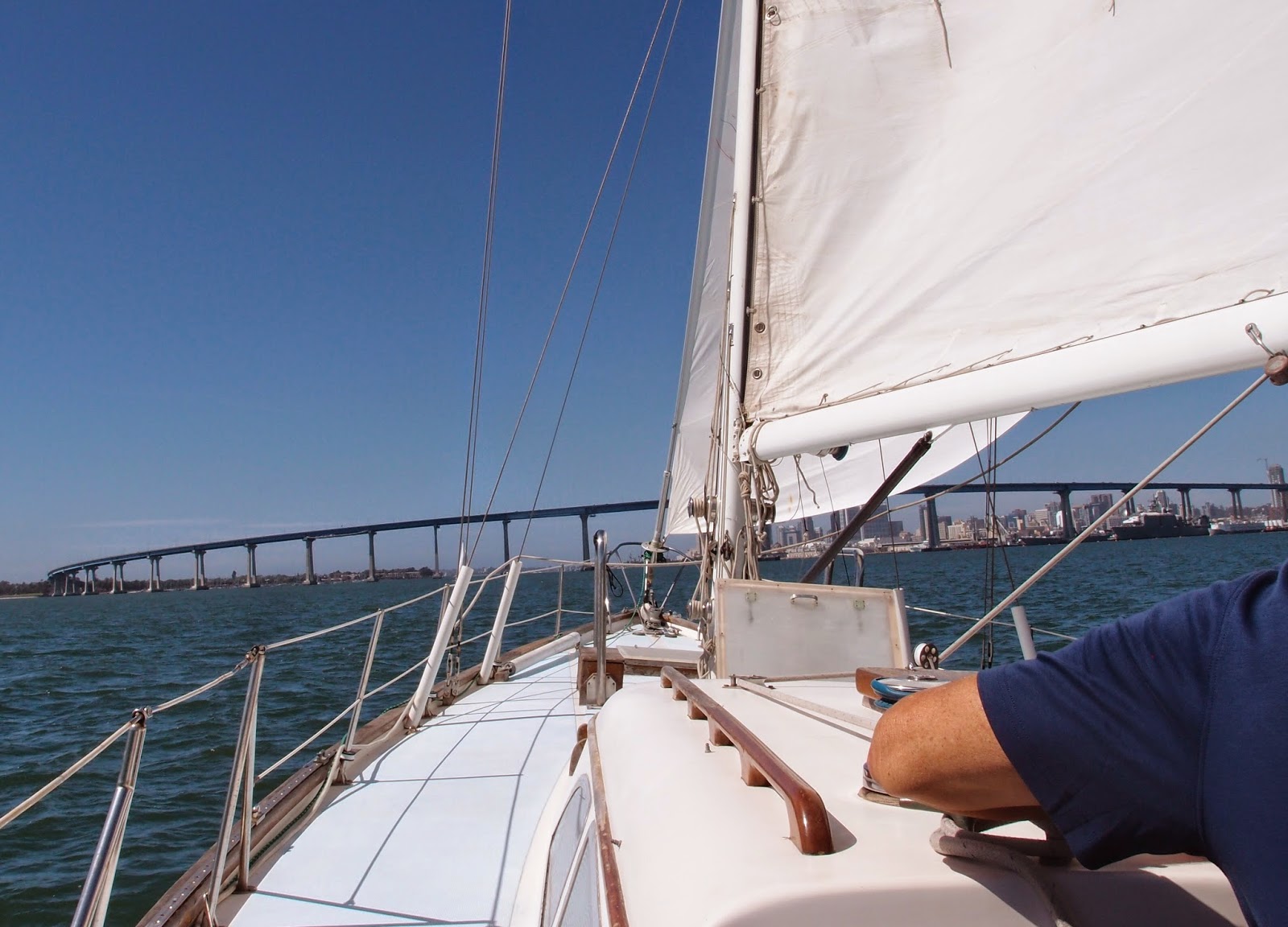
Approaching the Coronado Bridge.
Kevin assigned me the first trick at the helm so I got to work the big sloop upwind under the Coronado Bridge and past downtown. Kevin and Blair kept up a discussion on sailing priorities. It ended with the decision that you could be stupid as long as you didn't make the boat and her crew look stupid. I'm proud to say that, while I wasn't a great helmsman, at least I didn't make the boat and crew look stupid.
The Star of India with the San Diego skyline in the background.
There was plenty to see on San Diego Bay. Beautiful boats and ships, from aircraft carriers and the square-rigged Star of India to other boats sailing on the bay, all held my attention. We even sailed past a Columbia 43 on her mooring. The San Diego skyline and waterfront was beautiful from the water with big buildings, a waterfront park with an enormous statue of a sailor kissing a nurse. Past downtown the buildings and commercial waterfront gave way to moored yachts and Navy vessels.
Virginia at the helm.
At the mouth of the bay we turned back. Kevin assigned Virginia the wheel and went below to make sandwiches with Lisa. Just then, pod of dolphins surfaced within a few feet of the boat. I was the first to spot them and, thinking the San Diego folks saw this all the time, I tried to be casual when I announced their appearance. Lisa was out of the cabin like a shot. "We never see dolphins in the bay!" she said, "only sometimes in the ocean."
Lisa and Kevin making sandwiches down below in Skylark.
Virginia had the most challenging trick at the wheel sailing downwind. Sometimes the course dictated that she sail dead downwind with the sails wing-and-wing. Blair sometimes served as a human whisker pole until he got bored. We returned to Fiddler's Cove Marina when the sun was low on the horizon. Kevin is a great teacher and we learned a lot about sailing and docking the boat and the best way to fold sails at the dock. Skylark is a beautiful boat and Kevin has her dialed in for sure. We plan on staying in San Diego Bay for about a month this fall. I'm eager to get to know Kevin, his family and bay better.
On the way back to our hotel, every comment Virginia and I made about the day ended with "wasn't that great!"
We spent the next day at Disneyland We were in line before 8 a.m. staying nearly to the midnight closing. Lest you think we have amazing endurance, I must admit we went back to our hotel for a two-hour mid-day nap.
Thursday was Minney's Yacht Surplus day. We found a very crispy 135-percent genoa and a like-new storm staysail. I couldn't resist the symmetrical spinnaker made for a Columbia 43. It was old, but in perfect shape. We were hoping to buy an asymmetrical cruising spinnaker, but they didn't have one the right size for our boat at the time. I also found a winch that fit the base of the missing winch on our mast. We combed the store and found a few other needed items. It would have been easy to go nuts; the store really has a lot of great stuff at good prices.
I surprised myself because I was anxious to the point of stomach upset over the transactions. (We had a couple sails and a winch to trade in addition to our purchases.) I needn't have worried, Mr. Minney and his three crew members were friendly, patient and helpful. We felt good about the whole experience, which took the better part of a day.
While at Minney's, we also picked up a mainsail and genoa for Harry James, who is restoring a Columbia 38 in the Napa Valley Marina. After a quick visit and overnight stay with a cousin in the Bay Area, we met Harry in the flesh after years of reading each other's postings about boat restoration.
Harry's boat, Sheer, on the hard at the Napa Valley Marina.
Harry has long been an admirer of the Columbia 38 and finally bought one three years ago with the intent of restoring it over one winter. As I said, that was three years ago. But the work Harry has accomplished is top notch and the boat, Sheer, is a beauty. You can read about his adventures here. His plan is to truck the boat to Port Townsend this summer, do the final commissioning there and then sail it home to Alaska.
After leaving Harry, we wound our way to Highway 101 through the Napa Valley wine country. We decided to take the long way home and see the redwoods stopping the night at Eureka. The next day we checked out marinas at Eureka, Crescent City and Brookings for future reference.
It was a great trip with a great traveling companion. The experience made us look forward with even more enthusiasm to when we will be traveling full time on our sailboat.
A few weeks after we moved aboard we looked at each other and smiled. "What are you feeling right now?" I asked my wife. She thought for a minute and answered, "Content."
I think about that a lot over the last few months. While we have had some frustrations -- I'm thinking plumbing right now -- the overall feeling is contentment. Perhaps that's why I haven't been as regular at posting to this blog. It's not that there isn't a lot of exciting things to post about, there is. We are still busy getting the boat ready. The last few months have been a blur of buying and installing gear that will turn Oceanus into our own escape module to take us places we now only dream about.
Impulse, another Columbia 43, fitted with a Hydrovane.
We recently took delivery of our new Hydrovane, an auto-steering device that uses the wind to keep the boat on course so you can do other things. The Hydrovane is made in Nottingham, England. Yes, that Nottingham: Robin Hood, Sherwood Forest, Sheriff of, and so on. This prompted Virginia to name our newest crew member Maid Marian. Sadly, the Maid must remain in her boxes for a couple more weeks while we continue to work on more pressing matters, but it's exciting to have her onboard nonetheless.
One of Ocean's 11 winches clean and ready for lubricating.
I continue to work on the wiring and plumbing. We now have running water, but hot running water is still in the works. Wiring and plumbing is frustrating, difficult work for me, so I intersperse it with fun stuff, like servicing the 12 winches aboard Oceanus, finishing up some woodworking projects or rehabbing our dinghy.
Tethys getting new inwale and outwale. I used more than 50 clamps on the new rails while the epoxy set.
Working on the dinghy is the most fun. We named her Tethys, who was the wife (and sister) of Oceanus in Greek mythology. I bought the little 8.5-foot dinghy last year. We are still trying to figure out who made her and when. I believe she is at least as old as old as Oceanus (1971) because she did not have a Hull Identification Number, which was required after 1972. I had her inspected by the marine deputy and recently received a new HIN and clean title from the Oregon State Marine Board. While her hull is sound, the wooden thwarts and gunnels were in bad shape. I was able to rehab most of the wood making up the thwarts, but the gunnels had to be replaced. Getting them off was a chore -- they were both riveted and screwed on. Once I got them off, the project became pure woodworking bliss.
New quarter knees clamped in place while the epoxy sets.
I reinforced the transom, added teak quarter knees and a breast hook to strengthen the boat, since we bought a little 2.5 hp Lehr outboard. For such a tradition-looking dinghy, not having quarter knees and a breasthook just didn't look right to my eye, so I would have made then anyway. They also make wonderful handholds for lifting the dinghy or pulling her up on the beach. When I epoxied the new gunnels on I ended up using more than 50 clamps. I think the clamps weighed more than the 90-pound dinghy. After the epoxy set I added screws, countersunk and plugged, of course. She's all done except the painting, which Virginia is itching to do.
Yesterday brought a pair of Dinghy Dogs in the mail. These are two large inflatable hot dogs that attach to the side of the dinghy to make her more stable. Since they don't drag in the water, the won't hurt the wonderful rowing qualities of the dinghy, but they will make it unsinkable and more stable for beach landings through the surf, scuba diving off the dinghy and getting in and out of her from the mother ship.
Turkey breast dinner with all the fixings cooked in the pressure cooker.
Just learning to live aboard is fun. Virginia continues to amaze me with her cooking using only an induction hot plate and microwave while I figure out the propane installation. Her new pressure cooker is the go-to cooking implement. We got a pressure cooker for our wedding 38 years ago, but we really only used it to cook mashed potatoes. Then she got this new one and it's amazing; no rattling, hissing, steaming, or any of the stuff we associated with the old pressure cooker. The new one has a little yellow button that pops up when it comes to pressure and it quietly cooks away with no noise or steam, which helps keep moisture out of the boat. Among other things, she cooks cheesecake, brownies, crème brûlée, amazing Hawaiian pork, some of the best pork chops I've ever tasted, a turkey breast, and the lingcod that our fishing friend Tom McAdams gives to us about once a week.
The shoppers
Yes we had sunshine on the Oregon coast!
Over Presidents' Day weekend we had our oldest granddaughter and our youngest daughter-in-law come stay with us on the boat for three nights. It was a good test of having guests aboard. It went really well and we all felt comfortable (even me). Not only did we have room for our two guests, but we easily stowed the wheelbarrow-full of shoes and clothes they bought with Virginia at the Woodburn Outlet Mall.
Having guests, especially of the female persuasion, meant I had to finally hang the teak door on the head. The door came from an old wooden boat that was parted out before it sank. It took a lot of stripping and sanding, but the door is now really beautiful. I paid $100 for it. I'm sure I would have had to spend at least that much to buy just the wood to make a door. Before anyone mourns the passing of a "beautiful old wooden boat" this one needed to die. It was rotten through and through. To top it of it was named Love Child. Ick! The bad news is every time I tell the story I can't get the song out of my head.
One of the most popular blog posts of last year was Making Big Decisions at the Big Seattle Boat Show about last year's trip to the show. I received many comments and advice from readers, which I really appreciate. Last year we made a few key purchases, but we left the big ones for this year.
We attended the show on my wife's 60th birthday. "The sound of my screaming you hear on that day will not be from me turning 60, but from all the money we will spend," she told our friends.
Here's what we bought and what we didn't:
Built to last: Hydrovane and my wife.
Hydrovane
Last year we decided that a Hydrovane would be the best self-steering device for our Columbia 43 sailboat. We didn't buy it then and we are glad we didn't. The Hydrovane is made in the UK and the Pound is weaker than the Dollar right now. With the "boat show price," we saved about $1,200. Even with the savings, it was our largest single purchase so far for the boat.
We are pleased and excited about it nonetheless. Mike Snyder, who owns Distant Dreamer (the Columbia 43 that won her class in the 1971 TransPac as Encore) contacted us last year and said the Hydrovane works superbly on his boat.
Adios sailing on the Columbia River.
New mainsail
We actually decided to buy a new main from Dale Waagmeester, the sailmaker for Banks Sails Northwest, at the "little" Portland Boat Show. There is not much to interest sailors at the Portland show, but it's a fun date. We met Dale at a previous show and liked him immediately. He is making us a full-battened, loose-footed main that he says will be bulletproof. Our old main belongs in a museum.
We are also getting a Strong Track. With the full battens, we will need it. Dale made a full-battened main for Adios, a Columbia 43 that's famous on the West Coast for it's racing and cruising accomplishments. Craig Shaw, the owner, really likes the main and highly recommended Dale.
Lazy jacks
A couple years ago we attended a seminar at the Seattle boat show put on by Port Townsend Rigging. We were impressed with their lazy jack system. It looked to us like they had perfected it. This year we ordered ours at the show from Lisa Vizzini. This was another case where it paid to wait. Because they now price the system "a'la cart," we saved a few dollars.
Lehr propane-powered outboard
Last year we decided we would get a Lehr 2.5 hp propane-powered outboard for our dingy. So when we saw them at the show Virginia walked right up and showed them the money. After much running around and wasting our time by the rep, we gave up. Turns out his dealers didn't have any to sell, so we'll just buy one later from West Marine. The $100 rebate was not worth the hassle.
We are still excited about getting one, in spite of the poor system in place for buying one at the show. One sailing friend in Tacoma says he loves his.
Virginia models her new foul-weather pants and boots while holding the San Juan Islands: A Boater's Guidebook.
Pants!
Virginia's quest to find a pair of foul-weather pants that were comfortable and fit finally came to an end at the show. She found the perfect pair made by Gill at the Seattle Sailing Club booth. She bought a pair of boots too. Thanks SSC!
Dickinson Mediterranean galley range
We decided that the old, hand-me-down propane stove was just too scary to use. We have no idea how old it is or even what brand it is. There is no lock on the door either. As if propane on a boat is not scary enough, big chunks of rust fall out of it just about any time we moved it.
After looking on online, we decided before the show to go with a Dickinson Mediterranean three-burner propane stove. The Force 10 three-burner was a close contender, but the Dickinson is clearly better in our opinion.
Sure Marine in Seattle had the best price on the web, so we visited their booth at the show. Unfortunately they were sold out of the Mediterranean. We went ahead and purchased the Dickinson Newport, a propane fireplace, and an 11-gallon water heater. I made arrangements to pick it up at Sure Marine's store the next day while Virginia played with some of the grandkids.
On my way to Sure Marine on Friday, I stopped in a Fisheries Supply, the largest chandlery in Seattle. I saw they had the Dickinson Mediterranean on display, but a Fisheries employee looked it up on the computer and found they were sold out as well. Discouraged, I walked back to pick up some rigging supplies.
I asked the fellow who helped me in the rigging department if there was a manager on duty. He directed me to Dave at the front counter. I found Dave and introduced myself and told him I really wanted to return home to Newport with a Mediterranean cookstove. Would he sell me his display model?
We came to an agreement that was about $100 less than the price I would have paid at Sure Marine. And I wouldn't have to pay the $200 shipping from Seattle to Newport. The wood cutting board that comes with the stove was missing, but I can make a new, better-looking one. I was happy. Thanks Dave!
Dickinson Newport
In last year's boat show post I wrote about a forced-air diesel heater made in Finland. While these are very nice units, we decided to go with the simple and less expensive Dickinson Newport 1200. Mounting one on the bulkhead close to the mast is near the center of the boat and should keep us warm and cozy.
Harry James, a friend of mine from Alaska who is restoring an old Columbia 38/Constellation, gave me this good advice: "In Southeast Alaska, where reliable, dry heat is essential, I see lots of cruisers come north every summer. The majority have some variation of the Espar or Walbro furnace. I also see lots of commercial boats; none of them have an Espar or Walbro heater. I have never seen one on a commercial fish boat. There's a clue there. The Primary heat stove for the commercial fleet is some form of a Dickinson. "I've skippered a 65-foot 73-year-old classic power boat since 2009. The Dickinson cook stove on it runs 365 days a year without a hiccup. If you are planning on living aboard in the Pacific Northwest, then you need some kind of reliable, simple diesel heater. I have a Dickinson Newport ... I remember a trip in my Triton from Juneau to Pelican in 2008. I pulled into Lisianski Inlet and anchored after 15 hours in the cockpit in 55 to 58-degree weather. The warmth from my little Dickinson left a memory that makes me feel good still."
'Nuff said. Thanks for the good advice Harry. It saved me time and money and will give me better results I'm sure.
We decided to go with the propane Newport over the diesel on the advice of the folks at Sure Marine. Running the propane line will be much simpler than the diesel line with a fuel pump too.
Northwest books and charts
Since we hope to go north in the spring before heading south in the late summer, we bought San Juan Islands, A Boater's Guidebook from Heather Bansmer, who wrote it along with Shawn Breeding.
We thought it was about time that we updated our San Juans Afoot and Afloat book we used when we cruised the San Juans. The book got dog-eared from using it every summer with our three kids and a boarder collie in a 27-foot sailboat in the late 1980s and early '90s.
Heather and Shawn are also the authors of two excellent guidebooks we have: Sea of Cortez and Pacific Mexico. It was nice to meet Heather. We love all of her and Shawn's books.
We also bought two cruising atlases from Evergreen Pacific: West Coast of Vancouver Island and Northwest Waters, which covers from Olympia to Queen Charlotte Sound. No shipping or sales tax and a 20 percent boat show discount. I couldn't pass it up.
Cali-optics binoculars
At last year's boat show I looked at the 7X50 binoculars that are a Chinese knockoff of a much more expensive German brand. I didn't buy them, but wished I had. So this year, I did. The optics are amazing! Viewing at night is super bright. These are the best binoculars I've ever looked through and they have a compass. The boat show deal was about $100 off their internet price.
Pam Wall
The only seminar we had time to attend was the two hours presented by Pam Wall. I have a lot of respect for her and her late husband. These folks were out cruising and raising their kids on board their boat when I was still in high school. She had a lot of great ideas. One of my favorite was putting reflective tape on your mast, stantions and other places so your boat is more visible at night.
Hauling out Oceanus was only one of a list of accomplishments in 2014.
2014 was a seminal year for Virginia and me. We made several major steps toward our goal of cruising full time. Last year left us exhausted, but elated. Here's a list to buoy us up and to inform our readers.
Sold our house
Our house was a very very very fine house. We don't miss it.
Leaving the house we lived in for 11 years and getting rid of a lifetime of stuff was the hardest thing we did last year. Maybe in the last 10 years. We were pretty excited when we got a near full-price offer less than a week after we put it on the market in early summer. The excitement faded quickly when the buyer's agent fired off the first of nine adversarial revisions to the offer. The deal almost collapsed several times until finally closing more than four months after we put the house on the market.
Even though we loved our 1400-square-foot house, it was clearly too big. "The only thing I miss is my bathtub and washer and dryer," Virginia said.
Getting rid of our stuff
We are not hoarders by anyone's definition. But still we accumulated a small mountain of stuff. Paring it down to what fits in our Columbia 43 was just plain hard work. We sold tools, wood and excess boat stuff on Craig's List and on Ebay. Our kids rented a large truck and hauled away tables, chairs, beds, pots and pans.
With each trip to the dump or truckload of donations to the thrift store we felt lighter and more free. In the months since we haven't missed any of it.
Hauling out
Sanding down to the original gelcoat.
I hoped the haulout would take only two weeks. Boy, was I naive! It took almost seven. But the haulout was worth the effort, we:
sandblasted the bottom and the keel taking off about six layers of old bottom paint;
sanded, faired with epoxy the keel and bottom;
painted three coats of epoxy barrier coats on the bottom and keel;
painted two coats of Trinidad hard bottom paint;
removed four through hulls and repaired the hull with epoxy and lots of fiberglass;
installed three new through hulls;
replaced two old through hulls;
unstepped the mast and rewired it as well as taking apart all the rigging and inspecting it;
removed an old transducer and replaced with a new one;
removed rust and painted the mast step;
made rigging improvements to the mast;
sealed deck with epoxy around mast partners;
removed and replaced the cutlass bearing;
more than doubled the capacity of the cockpit drains
and the most noticeable improvement -- we spent days and days sanding fairing and sanding some more before having the topsides professionally painted with the AwlCraft 2000.
It was the most physically demanding work we've done in a long time. We literally worked our butts off: we lost weight even eating almost exclusively fast foot for the entire haulout. We called it the boatyard workout. And it was every day, all day for both of us.
Toward the end of the haulout it was tough to haul our tired selves out of bed. "This is like the movie Groundhog Day," Virginia complained, "the same hell every day. Sanding and fairing and sanding some more."
It was dangerous too. Oceanus's deck was 12 feet off the ground and we made dozens of trips up and down the ladder each day. We also worked on scaffolding and with power tools. To make things even more scary we had no health insurance because we both ...
Quit our jobs
It was hard leaving a job I enjoyed and which provided a regular paycheck. It felt like stepping off into the abyss. I miss many things about the job, especially seeing my many friends.
Virginia resigned as a full-time nurse, but still works per-diem at the hospital, picking up about three 12-hour shifts a month. She is something of a minor celebrity when she returns. Her co-workers introduce her to patients as the nurse who lives on a sailboat and is about to sail away.
Oceanus leaves the dock under her own power
Oceanus heads down the river after her haulout. For 12 years she didn't leave her slip.
For most boats this wouldn't be a big deal, but Oceanus hadn't left her slip, except with the help of a tugboat, for more than 12 years. When a previous owner trucked her to Oregon from California he launched her at the Toledo Boatyard and found the engine didn't work. So he hired a tug to tow her down the river to Newport where she stayed in her slip for 12 years.
One of the things Jason, the owner we bought her from, did was rebuild her Perkins 4-108. But several engine issues remained when we bought her, including a leaking raw water pump and a prop that was the wrong size. Jason helped me replace the water pump and, after two trips to Astoria and three attempts by a professional diver, we installed the proper propeller.
Selling Ravn
I sold my beloved faering in 2014.
I suppose I should have included this in our second section, but Ravn deserves special mention. I wanted to build a faering for more than a decade and in 2010 finally finished a 19-foot version designed by Atkin. Before our lives changed, it was to be my last boat. I even joked that my family could use it to give me a Viking funeral when I died.
I loved that boat and poured three years of hard work and the finest wood I could find into building her. She was and is a head turner and won the People's Choice Award at the 2011 Toledo Wooden Boat Show. So selling her was a big deal to me. Luckily I found great new owners for her in Paul and Maryann. It helps that they are good friends and love the boat almost as much as me.
Finishing the head
Virginia gives a final coat of paint to the head.
The most unfinished space in the boat when we purchased her was the head. It was wonderful to build it just the way we wanted it, but it was a lot of work too. It turned out great with an AirHead composting head and a real bathtub.
Bimini and two enclosures
Virginia used the first enclosure, made from Sunbrella View, as a pattern for one made from clear vinyl.
Virginia's skillfulness and ingenuity never ceases to amaze me. With the help of a local canvas guy, she designed and then he fabricated a stainless steel tubing frame for the bimini. Then she sewed the canvas for it, including a small window so you can see the masthead fly from the helm.
During the haulout (while the boat was in the paint tent and out of the wind) she patterned an enclosure. Once the boat was back in the slip, she sewed a warm-weather enclosure out of Sunbrella View fabric. Then she used that as a final pattern to sew an enclosure with clear vinyl windows for rainy, cold Northwest winters. Since we moved aboard, we are thankful for it every day for the enclosure.
Cabin sole
Varnished teak on the saloon sole gives way to paint with non-skid beads in the rest of the boat.
The plywood cabin sole of the boat was strong, but ugly. We considered several options, but in the end we replaced the ugly plywood in the main saloon with beautiful marine-grade teak plywood and varnished it. In the rest of the boat we cut access hatches to every section of the bilge, then faired, sanded and Virginia painted it. It looks good and is easy to care for.
Painted deck and non-skid
Virginia primes the deck for the first coat of non-skid.
Another huge project Virginia did almost singlehanded was stripping the old paint from the decks of Oceanus and repainting. The decks were repainted several times over the years filling the weave of the original non-skid pattern and making it unsafe. The decks also just looked ugly!
Virginia spent countless hours on her knees using Citrus Strip and a wire brush to prep the decks for painting. Then she did most the painting herself. I only helped with the tipping of the polyurethane paint in the water channels that border the non-skid sections.
Other projects
Oceanus never had curtains until Virginia sewed them using Sunbrella and a track from Sailrite.
We finished several other projects including more wiring, a real AC panel, plumbing projects, a 600-amp house battery bank and a 60-amp Sterling smart charger for the house battery bank and engine battery. I also rebuilt three more hatches and installed a freezer. Virginia sewed curtains for the main cabin. I will highlight several other projects in future posts.
As the haulout stretched into late October it became painfully clear to us that we were not going to sail south in 2014. The weather window slammed shut just days after we relaunched the boat. We also have several projects that need finishing before Oceanus is ready for blue water.
While we really wanted to celebrate last Christmas in the Sea of Cortez, moving our departure date forward has its advantages. One is that we will be around when our eighth grandchild is born in early May.
Another is the relief we felt when the deadline pressure was off. We now will have time to sail north and do our shakedown cruise in the familiar waters of San Juan Islands and Puget Sound. We will then sail south and take our time exploring the Channel Islands and other places in California before going to Mexico in the late fall.
Our little nativity scene on our starboard deadlight is both lovely and space efficient. It has the added advantage of staying put when 50-knot gusts rock the boat.
Merry Christmas everyone. We are having a wonderful holiday both on and off the boat this year. Hope everyone else is too.
Brandon and Virginia
A Seafarer’s Christmas Poem
by Robert Louis Stevenson
First published in the Scots Observer in 1888
The sheets were frozen hard, and they cut the naked hand;
The decks were like a slide, where a seaman scarce could stand;
The wind was a nor’wester, blowing squally off the sea;
And cliffs and spouting breakers were the only things a-lee.
They heard the surf a-roaring before the break of day;
But ’twas only with the peep of light we saw how ill we lay.
We tumbled every hand on deck instanter, with a shout,
And we gave her the maintops’l, and stood by to go about.
All day we tacked and tacked between the South Head and the North;
All day we hauled the frozen sheets, and got no further forth;
All day as cold as charity, in bitter pain and dread,
For very life and nature we tacked from head to head.
We gave the South a wider berth, for there the tide-race roared;
But every tack we made we brought the North Head close aboard:
So’s we saw the cliffs and houses, and the breakers running high,
And the coastguard in his garden, with his glass against his eye.
The frost was on the village roofs as white as ocean foam;
The good red fires were burning bright in every ‘longshore home;
The windows sparkled clear, and the chimneys volleyed out;
And I vow we sniffed the victuals as the vessel went about.
The bells upon the church were rung with a mighty jovial cheer;
For it’s just that I should tell you how (of all days in the year)
This day of our adversity was blessed Christmas morn,
And the house above the coastguard’s was the house where I was born.
O well I saw the pleasant room, the pleasant faces there,
My mother’s silver spectacles, my father’s silver hair;
And well I saw the firelight, like a flight of homely elves,
Go dancing round the china-plates that stand upon the shelves.
And well I knew the talk they had, the talk that was of me,
Of the shadow on the household and the son that went to sea;
And O the wicked fool I seemed, in every kind of way,
To be here and hauling frozen ropes on blessed Christmas Day.
They lit the high sea-light, and the dark began to fall.
‘All hands to loose topgallant sails,’ I heard the captain call.
‘By the Lord, she’ll never stand it,’ our first mate, Jackson, cried.
. . .
‘It’s the one way or the other, Mr. Jackson,’ he replied.
She staggered to her bearings, but the sails were new and good,
And the ship smelt up to windward just as though she understood.
As the winter’s day was ending, in the entry of the night,
We cleared the weary headland, and passed below the light.
And they heaved a mighty breath, every soul on board but me,
As they saw her nose again pointing handsome out to sea;
But all that I could think of, in the darkness and the cold,
Was just that I was leaving home and my folks were growing old.
(Thanks to John Kohnen, the King Coot of the Western Oregon Messabouts, for reminding me of this great Christmas poem from my favorite author.)