|
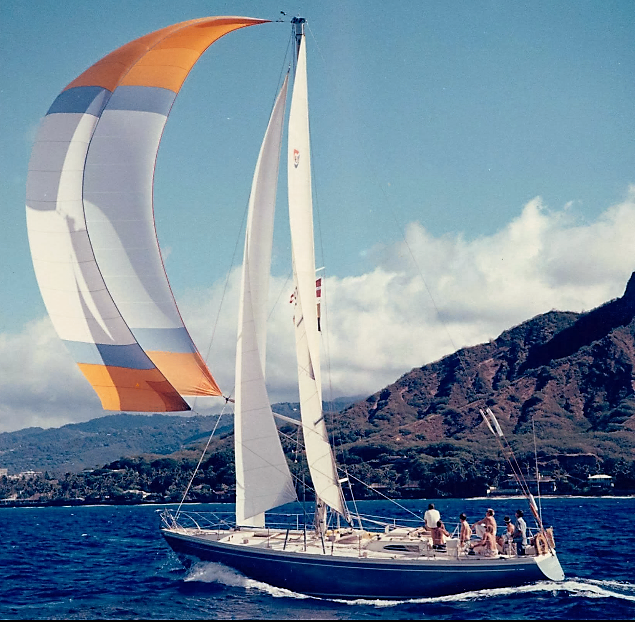
| The Stumppy J heads for the finish line of the 2013 Transpac race from Los Angeles to Honolulu. |
by Brandon
The tactician, sailmaker and navigator aboard the
Stumppy J said the Columbia 43 Mark III "exceeded expectations" during the 2013
Transpac race from Los Angeles to Honolulu.
"Being an old CCA design, I was not sure how she would do in the big rolling swells of the open ocean, but she loved to surf under spinnaker," said Mike Price. "We would regularly come tearing down the faces of big 8- to 12-foot rollers and surge in to the 11 and 12 knot spectrum."
The 2013 Transpac, which is 2,225 nautical miles as the crow flies, had everything from a gale-force tempests, to cloudless blue skies with a warm following breeze, Price said. The first five days were very wet, often squalls and gales that would materialize, seemingly, out of nowhere. The first night had winds of 30 to 35 knots and the
Stumppy J sailed under a double-reefed genoa and full mainsail on a close-reach. The boat hit 13.2 knots while blasting down a wave, Price said.
"No one on the crew got to take off their foul-weather gear until about the sixth day because it was so wet above deck," he said. "It was comparatively calm after the seventh day when we were firmly in the tropics and the rainfall was warm and pleasant. The wind would still pipe up into the 20s -- but it was a warm wind at our backs. I spent the last week in a jacket, no shirt underneath, and shorts all night during my midnight to 4 a.m. watch."
 |
| The Stumppy J at the start of the 2013 Transpac |
The boats were in three doldrums during the race. "That was a bit of a pain," Price recalled, "but everyone else was in them too, so the fleet as a whole got to suffer a few days." At one point, the wind went totally dead on the race course and a few of the crew jumped in the ocean for a brief swim.
On the fourth day out the
Stumppy J logged nearly 200 nautical miles in 24-hours.
"We had the Code 2A (asymmetrical spinnaker) up with a staysail inside of it and the mainsail at full hoist and were doing 9s and 10s on the GPS, surging regularly into the 11s and 12s," he said. "It was stormy weather, with winds ranging between 15 and 25 knots, making for a 24-hour adrenaline rush!"
You would think that would be the high-point of the race, but for Price, the best part of the race came during the last night at sea.
"We cooked a last supper and broke out the guitar and ukulele and the whole crew jammed and sang songs for two hours while blasting along between 8 and 10 knots under spinnaker," he said. "I wish that night never ended, there was such merriment and cheer on board... what began as a crew had become a family."
 |
| The crew of the Stumppy J upon arrival in Honolulu at the end of the 2013 Transpac. Skipper Ed Stumpp is the second from the right. |
The
Stumppy J, finished the 2013 Transpac race on July 22 with an elapsed time of 14 days, 11 hours, 33 minutes and 35 seconds. She finished sixth in Division 8, the same division as another, more-famous old timer, the 52-foot Sparkman & Stevens yawl
Dorade. Built in 1930,
Dorade won the Transpac in 1936 and took top honors this year as well.
Ed Stumpp, the owner and skipper of the
Stumppy J, planned from the time he bought the boat to enter it in the Transpac, according to Price. The
Log of Hagoth hopes to hear all the detailes from Stumpp himself.
Stumpp entered his boat in Southern California races as a warm-up for the Transpac and did well. Price was part of the crew for those races too.
"We made an impressive debut to the ocean racing PHRF SoCal scene with a 3rd-place finish in the 2013 Border Run Race (Newport Beach to San Diego)," Price said. "Then a come-from-behind first-place victory in the Catalina Island Series Race #4 (Isthmus Cove to Long Beach), beating the winner of the Newport to Ensenada race by 35 seconds."
Price praised Stumpp is a good leader and one able to make the crucial decisions on board. During the Transpac Stumpp "did an over-the-top good job in managing our various resources and crew mates," Price said.
Stumpp started to make improvements to his Columbia 43 Mark III soon after he bought it. He put in a new, tapered mast and new standing rigging on the boat. He rebuilt the main-sheet system, added a pad-eye to the foredeck for the tack a staysail, put in a solar panel bank, installed a watermaker, new keelbolts, new genoa sheets, new spinnaker sheets, new spinnaker halyards, and a new roller furler, among other things. Then, of course, he got the safety gear required by the TransPac race committee.
 |
| The Columbia 43 Mark III has a lead keel with less wetted surface than a regular 43's cast iron keel. It also has a skeg-hung rudder and six more feet of mast, which gives it a more powerful sail plan. Most Mark IIIs were built in 1973. |
A good part of the budget was for new sails. Over the course of this year, Price, who manages the Hyde Sails loft in Los Angeles, built a new, custom mainsail for the boat, a 155 percent genoa, and Code 2A asymmetrical spinnaker. The 155 percent genoa was optimized to roller reef down to 145 percent, 135 percent and 125 percent without losing any shape.
"We went with good ol' Dacron with the sails." Price said. "The mainsail was made with bullet-proof 10-ounce Dacron, designed with two reefing points and five battens. The top two battens are full to support a massive roach profile along the leech of the sail. We made her as big and powerful as legally possible. The genoa was made out of 9 ounce storm-sail cloth and optimized to roller-reef without losing any shape. That proved to be a valuable and versatile design that allowed us to shift gears in the rapidly ranging wind conditions."
A Code 5A asymmetrical spinnaker was made of 1.5 ounce spinnaker cloth; the same weight as the other spinnaker on board. The other sails were a 105 percent storm jib made of heavy Mylar-Kevlar and a staysail.
"We used every sail except the storm jib and spent days four through seven under the code 2A until we blew it up," Price said. "We finished under the code 5A. Being the sailmaker on board, I had repaired the code 2A when we had put some tears in it during a botched spinnaker drop (that resulted with the spinnaker going in the water), but after a few days and a couple of bad round-ups, we managed to blow her up and she was no longer repairable with the tools we had on board. I'll be putting her back together in my loft after the boat returns from Hawaii."
The Columbia 43's staysail got a lot of use too.
"We used the staysail for ten days straight, only dropping her if we had to gybe or if the breeze dropped below 10 knots, which made it too difficult to refill the spinnaker if it were to collapse," Price said. "The staysail was good for about another quarter to half a knot, which on a 2,250-mile race is worth nearly half a day off of your total time."
Any problem areas other Columbia 43 owners should watch out for?
"The boat itself was, and always has been, fine," Price said. "Columbia 43's are so overbuilt that if a nuclear bomb ever goes off, there will only be roaches and Columbia 43's left in the rubble."
The crew did daily checks on everything from hull compression to keel-bolt tightness to rigging tension. Nothing ever needed adjustment or was cause for concern, Price said.
"We did put some serious wear on the rudder-post bearing, which was still fine when we arrived in Hawaii, but will need servicing," He said. "A lot of other competitors had similar wear and some broke their rudder-post bearings; there were some turbulent storms during the crossing."
Price said there were very few equipment failures aboard during the race.
"The first 36 hours were very stormy," he said. "Gales bringing wind as high as 40 knots with waves breaking over the entire boat. This allowed some moisture to trickle down a bulkhead into a socket, which caused a small electrical fire and claimed our 110-volt inverter."
The binnacle-mounted GPS stopped receiving satellite feed by the third day for no apparent reason. So the crew navigated the whole rest of the way with a hand-held GPS.
"My advice to others who will someday make the crossing is to spare no expense in your foul-weather gear and safety gear," Price said. "I wear Gill's top-of-the-line jacket and bibs over my layers of thermal clothing and waterproof racing boots so that I was both warm and dry the entire trip. I also have a personal EPIRB that I wore under my strobe- just in case the unthinkable were to happen."
Columbia 43s have a reputation as a great sea boat with a kindly motion. Price said he found that to be true, but, like every boat, the 43s have their strengths and weaknesses.
"The hull shape likes to keep the highly-powered sail plan on a broad reach at an angle travelling with the faces of waves," he said. "Any waves striking the vessel at an angle have a tendency to throw the stern one way or the other, which could either trigger a round-up or accidental gybe. The boat overcomes this by having such a balanced helm- it literally felt like power steering. In fact, corrective steering often needed an immediate counter-correction because it only took a small adjustment on helm to return her to proper course."